




Benefit segmentation Explained: Marketing Strategy, Definition, Examples

Emily Sullivan is an experienced marketing professional with over a decade of expertise in content creation, communications, and digital strategy. She thrives on translating complex, technical subject matter into content that is approachable, insightful, and genuinely useful to marketing professionals navigating a fast-evolving landscape.

Ola Wolski is a marketing research professional with nearly seven years of experience in social media strategy, innovative research, and data-driven marketing measurement. She thrives on digging into complex data to surface the clear, actionable insights that help brands measure what matters and invest with confidence in a rapidly evolving digital landscape.

- 1. Benefit segmentation definition in marketing
- 2. How benefit-based segments are identified
- 3. Benefit segmentation vs other segmentation models
- 4. Common benefit types used in segmentation
- 5. How benefit segmentation improves marketing performance
- 6. Common mistakes brands make with benefit segmentation
- 7. Fitting benefit segmentation into a broader customer strategy with fusepoint

In your weekly growth review, you may find conversion rates up and brand retention stable. Yet when the conversation turns to positioning or messaging, you find yourself scrambling to explain why customers choose your brand.
That uncertainty is a benefit segmentation problem.
Decades ago, marketing scholar Russell Haley showed that purchase decisions are shaped more by what customers want to achieve than by who they are.
Put simply, customers with no demographic commonalities may buy for the same reason. Others who appear identical on paper may seek very different outcomes: convenience versus control, price versus performance, speed versus reliability.
Benefit segmentation asks: What problem does this customer actually want solved? When you answer that question well, you stop marketing to personas and start marketing to priorities. That’s what turns segmentation from a reporting exercise into a decision engine for positioning, messaging, and product strategy.
Benefit segmentation definition in marketing
What is benefit segmentation? It’s the practice of grouping customers based on the specific outcomes, advantages, or value they seek from a product or service.
From a business perspective, this is important because benefits are what drive:
-
Willingness to pay
-
Sensitivity to discounts
-
Channel responsiveness
-
Message resonance
-
Long-term retention
When customers churn, it’s rarely because their demographics changed. It’s because the expected benefit was not delivered, or a competitor delivered it more clearly.
How benefit segmentation works
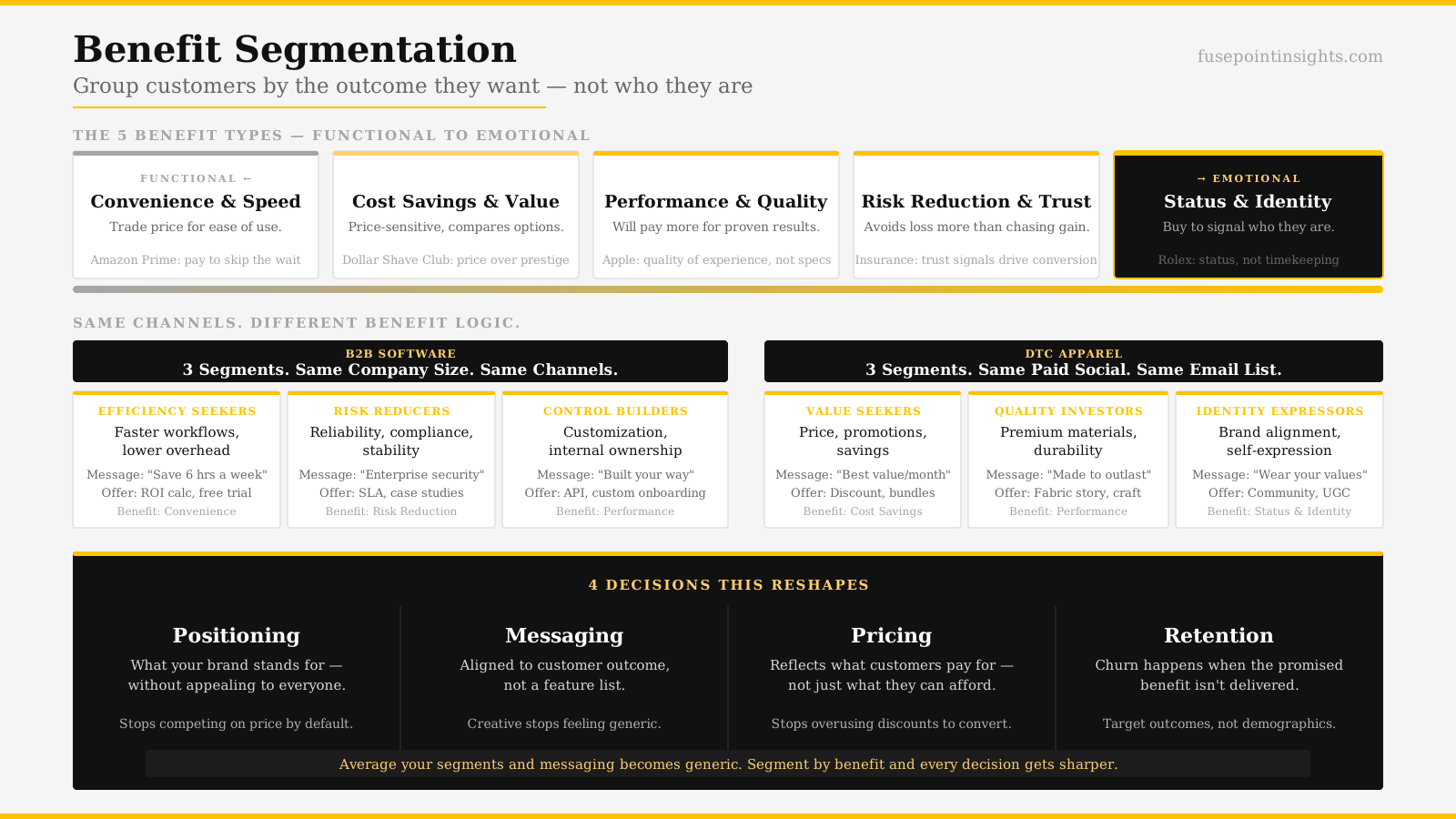
Consider a B2B software company with three dominant benefit-driven segments:
-
Efficiency seekers who want faster workflows and lower operational overhead
-
Risk reducers who value reliability, compliance, and vendor stability
-
Control builders who want customization and internal ownership, even at a higher cost
All three segments may sit inside the same company size range. All three may convert through the same channels. But they respond to entirely different messages, pricing structures, and onboarding paths.
Now consider a DTC apparel brand with three dominant benefit-driven segments:
-
Value seekers who prioritize price, promotions and maximizing savings
-
Quality investors who want premium materials, durability, and long-term product performance
-
Identity expressors who care most about brand alignments, style, and how the product reflects their personal identity
All three segments may buy the same product categories. All three may convert through the same paid social, email, or direct traffic channels. But they respond to entirely different creative, offers, and brand positioning.
Average them, and the messaging becomes generic. Segment by benefit, and suddenly it’s clear why certain promotions lift retention while others only drive one-time conversion.
Why benefit segmentation sharpens marketing strategy
Benefit segmentation works because it aligns marketing decisions with customer intent rather than surface-level traits.
When benefits are clear:
-
Positioning becomes precise – You can articulate what your brand stands for without trying to appeal to everyone.
-
Messaging becomes coherent – Creative aligns to the outcome customers care about, not feature lists.
-
Media becomes more efficient – Channels are chosen based on how customers seek solutions, not where they happen to exist.
-
Product strategy gains focus – Roadmaps prioritize benefits that drive retention and margin, not just adoption.
Most importantly, benefit segmentation creates internal alignment. Marketing, product, and finance can rally around the same logic: which benefits create value, and which customers deliver it.
How benefit-based segments are identified
In practice, brands surface benefit-driven segments through a combination of qualitative insight and behavioral evidence.
Customer research and surveys
Ask your customers what success looks like for them, what problem they were trying to solve when they purchased, and what alternatives they considered. The most useful questions focus on outcomes, not satisfaction scores.
Behavioral signals
Purchase frequency, feature adoption, discount sensitivity, support usage, and upgrade paths often reveal underlying benefits. For example, customers who churn after price increases are often driven by cost, not loyalty.
Messaging and content response
Different benefits respond to different narratives. A segment that engages with “time saved” messaging behaves very differently from one that responds to “risk reduction” or “performance gains.”
Customer insight analysis
Combining CRM data, product usage, and retention patterns helps validate whether stated benefits align with actual behavior. This prevents teams from over-indexing on survey answers alone.
Importantly, benefit segmentation does not replace other segmentation models. Instead, it complements psychographic and behavioral segmentation by adding decision logic.
Benefit segmentation vs other segmentation models
| Segmentation model | What it groups by | What question it answers | Where it’s strongest | Key limitation |
|---|---|---|---|---|
| Benefit segmentation | Desired outcomes, needs, or problems customers want solved | Why does the customer choose this product or brand? | Product positioning, value proposition design, pricing logic, differentiation | Requires strong qualitative and behavioral evidence; benefits can shift by context |
| Demographic Segmentation | Age, income, gender, company size, job role | Who is the customer? | Market sizing, reach estimation, media access planning | Weak contributor to predictive customer analytics |
| Psychographic Segmentation | Values, attitudes, motivations, lifestyles | What motivates the customer emotionally or ideologically? | Messaging, brand strategy, creative direction | Often hard to operationalize without behavioral or economic data |
| Behavioral Segmentation | Actions, usage patterns, purchase behavior, lifecycle stage | What does the customer actually do? | Conversion optimization, retention strategy, performance marketing | Explains behavior, but not always the underlying motivation |
When teams debate positioning, messaging, or pricing, demographic and behavioral segments tend to fall short. Knowing that a customer is “high-frequency” or “urban” does not explain what promise your brand should make to them.
Benefit segmentation cuts through that ambiguity. It aligns marketing around a clear value exchange:
-
This segment buys for speed, not savings
-
This segment values certainty more than flexibility
-
This segment is willing to pay more to avoid risk
Those distinctions directly inform creative strategy, channel mix, offer design, and product priorities.
Related: Demographics vs Psychographics
When benefit segmentation should be prioritized
Benefit segmentation becomes especially valuable when:
-
Multiple customer types convert through the same channels but respond to different messages.
-
Pricing debates stall because willingness to pay varies widely.
-
Retention is uneven despite similar acquisition performance.
-
Positioning feels generic or interchangeable with competitors.
In these moments, benefit segmentation provides clarity where other models blur the signal.
Common benefit types used in segmentation
Benefit segmentation works only when the benefits that matter are explicit. Across industries and buyer journeys, most benefit drivers fall into a core set of categories that consistently predict purchase behavior and long-term value.
Convenience and speed
Customers who prioritize convenience want solutions that reduce effort or time. They’ll often trade price or features for ease of use.
For example, quick delivery options drive conversion for consumers unwilling to wait (Amazon Prime’s 2-day delivery option is a key driver of retention).
Cost savings and value
These customers seek discounts, low entry cost, and high perceived return on spend. They’re price sensitive and often compare alternatives.
Dollar Shave Club initially succeeded by bundling blades at a lower price and emphasizing cost over razor brand prestige. Brand messaging around savings (“Best value per month”) and price anchoring can help reinforce the benefit.
Performance and quality
Customers in this segment will pay more for demonstrable superiority. For example, Apple’s positioning is not about price or speed alone, but about the quality of the experience. That focus lets the brand command a premium.
Risk reduction and trust
These customers avoid pain or loss more than they chase benefits. They value guarantees, transparency, and reputational signals. As part of benefit segmentation examples, consider insurance marketing, which leans heavily on trust and risk mitigation rather than price alone.
Status, identity, or emotional payoff
Some customers buy not for functional benefits but for how the purchase makes them feel or signals who they are. Rolex or Rolex-adjacent products are a prime example here: They succeed because customers buy status and identity.
How benefit segmentation improves marketing performance
Behavioral, demographic, and psychographic segmentation tells who or how, but benefit segmentation tells why. In competitive markets, this “why” drives purchase, retention, and willingness to pay.
According to Gartner, benefit-driven segmentation can increase marketing ROI by enabling more precise positioning and product-market fit.
When marketers understand benefit drivers:
-
Creative becomes purpose-built, not templated
-
Media strategies align with actual motivation paths
-
Pricing choices reflect what customers are willing to pay for, not what they can afford
-
Retention efforts focus on reinforcing outcome realization
That’s the shift from activity to value, and it’s where segmentation delivers strategic, durable advantage.
Common mistakes brands make with benefit segmentation
Despite all its advantages, benefit segmentation fails when it’s treated as insight rather than infrastructure.
Assuming benefits without evidence
Many teams declare benefits based on intuition or past positioning. Without research (such as qualitative interviews, surveys, and behavioral analysis), those assumptions may drift.
Over-segmenting into unusable slices
More segments don’t mean better strategy. If a segment cannot be targeted, messaged to, or measured differently, it’s noise.
Effective benefit segmentation typically yields fewer, sharper segments, not dozens of micro-clusters.
Treating segmentation as a marketing-only artifact
Benefit insights lose power when they live in a deck. Product, pricing, finance, and sales need to operate from the same benefit logic.
When teams disagree on why customers buy, execution fragments fast.
Failing to activate insights consistently
The most common failure? Segmentation that never changes creative, budgets, offers, or marketing performance measurement.
In fact, segmentation ends up being merely decorative if benefit insights don’t show up in:
-
Creative briefs
-
Media allocation
-
CRO hypotheses
-
Pricing decisions
Put simply, benefit segmentation improves performance only when it informs real choices.
Choosing the Right Metrics, Tools, and Tests to Drive Real Business Growth

 PDF
PDF
Fitting benefit segmentation into a broader customer strategy with fusepoint
Most organizations already collect customer insights through surveys, CRM data, and analytics. The problem now is a lack of structure. Benefit segmentation provides that structure by organizing insights around what customers are trying to achieve, rather than who they appear to be.
As a marketing science company, fusepoint treats benefit segmentation as part of a larger measurement and decision system, focusing on:
-
Grounding segmentation in observable behavior and profitability
-
Embedding benefit logic into media, creative, and experimentation frameworks
-
Continuously validating assumptions with data
Beyond improving your understanding of your customers, benefit segmentation can help you make better decisions every day. That’s where durable growth starts, and where fusepoint partners with teams who want customer insight services to change the trajectory of their businesses. Book a strategy call to see how fusepoint can turn your data into your competitive advantage.
Sources:
Sage Journals. Benefit Segmentation: A Decision-oriented Research Tool. https://journals.sagepub.com/doi/10.1177/002224296803200306
ResearchGate. Customer-Oriented Benefit Segmentation: An Integrated Approach. https://www.researchgate.net/publication/256065460_Customer-Oriented_Benefit_Segmentation_An_Integrated_Approach
ScienceDirect. Artificial intelligence in customer relationship management: A systematic framework for a successful integration. https://www.sciencedirect.com/science/article/pii/S0148296325003546
The New York Times. They Changed the Way You Buy Your Basics. https://www.nytimes.com/2020/01/23/business/Billion-Dollar-Brands.html
McKinsey & Company. The State of Fashion Watches & Jewellery – McKinsey. https://www.mckinsey.com/~/media/mckinsey/industries/retail/our%20insights/state%20of%20fashion%20watches%20and%20jewellery/state-of-fashion-watches-and-jewellery.pdf
Our Editorial Standards
Reviewed for Accuracy
Every piece is fact-checked for precision.
Up-to-Date Research
We reflect the latest trends and insights.
Credible References
Backed by trusted industry sources.
Actionable & Insight-Driven
Strategic takeaways for real results.
Emily Sullivan is an experienced marketing professional with over a decade of expertise in content creation, communications, and digital strategy. She thrives on translating complex, technical subject matter into content that is approachable, insightful, and genuinely useful to marketing professionals navigating a fast-evolving landscape.