




What is prescriptive analytics? Turning data into actionable decisions

Emily Sullivan is an experienced marketing professional with over a decade of expertise in content creation, communications, and digital strategy. She thrives on translating complex, technical subject matter into content that is approachable, insightful, and genuinely useful to marketing professionals navigating a fast-evolving landscape.

Scott Zakrajsek is a data-driven marketing executive with over 15 years of experience leading digital transformation for iconic brands. As Head of Data Intelligence at fusepoint and Power Digital, he specializes in turning complex data ecosystems into actionable strategies that drive growth.

- 1. What is prescriptive analytics?
- 2. How prescriptive analytics differs from descriptive and predictive analytics
- 3. Why predictive insights alone are not enough
- 4. Predictions don’t resolve tradeoffs
- 5. How prescriptive analytics works in practice
- 6. Practical prescriptive analytics use cases in marketing and growth
- 7. Prescriptive analytics is a system, not a tool

In a Monday morning exec meeting, the dashboards are up. Everyone agrees on the direction of last quarter’s results, but the room goes quiet when the real question lands: So what do we actually do next?
This is a familiar frustration for advanced marketing and growth teams. Descriptive analytics explains the past, and predictive customer analytics estimates what might come next. But neither tells you which lever to pull, how hard to pull it, or what tradeoffs you’re making when you do.
That’s where prescriptive analytics comes into play. It’s the layer that moves analytics from observation to decision-making, translating models and forecasts into clear, defensible actions. This guide breaks down prescriptive analytics in practical business terms and how it helps leaders move from insight to action.
What is prescriptive analytics?
Prescriptive analytics is the practice of translating data into specific, defensible actions. Where descriptive analytics reports performance and predictive analytics forecasts what might happen, prescriptive analytics answers the harder question: Given these conditions, what is the best move right now?
It does this by evaluating multiple possible actions against business objectives. That might include maximizing profit, reducing risk, accelerating payback, or protecting long-term growth. Instead of producing a report, prescriptive analytics produces a recommendation, often with ranked options and clear implications.
Importantly, while answering, “What is prescriptive analytics?”, you must remember that it’s not about automation for its own sake. It does not “decide” in a vacuum. It provides decision support by translating complex inputs into clear options, aligned with business priorities.
How prescriptive analytics differs from descriptive and predictive analytics
Now that they have access to an ocean of data, executives may struggle with decision-making confidence. The reason becomes clear when you step back and ask a more fundamental question: What is the difference between predictive and prescriptive analytics when the goal is actually choosing what to do next?
Descriptive analytics: What happened
Descriptive analytics looks backward. It summarizes performance and explains outcomes after the fact.
Examples include dashboards showing:
-
Revenue by channel
-
Conversion rates by campaign
-
Cost per acquisition over time
These views are essential, but limited. Consider: A report showing that paid social underperformed last month does not tell you whether to cut spend, change creative, shift targeting, or accept the result as noise.
Predictive analytics: What is likely to happen
Predictive analytics looks forward. It estimates future outcomes based on historical patterns.
In marketing, this often shows up as:
-
Forecasted conversions if spend increases
-
Predicted churn risk by customer segment
-
Expected return curves by channel
Predictive analytics narrows uncertainty, but it still stops short of action. It might tell you that increasing spend on Channel A will likely produce higher returns than Channel B, but not whether that increase aligns with margin goals.
Prescriptive analytics: What should we do, and why
This is where prescriptive analytics enters. But what is prescriptive data analytics in a business context?
It integrates performance data, forecasts, and business constraints into a decision framework.
Instead of presenting options neutrally, it evaluates them against objectives. For example:
-
If the goal is to maximize short-term revenue, the recommended action may differ from that optimized for customer profitability or payback speed.
-
If inventory is constrained, prescriptive analytics may advise reallocating spend even if a channel appears efficient.
-
If customer lifetime value varies by segment, it may recommend prioritizing retention over acquisition, even if top-of-funnel metrics are higher.
Ultimately, it’s a shift from analytics as information to analytics as guidance.
Why predictive insights alone are not enough
Most marketing teams today have no shortage of predictions. They know which channels are likely to grow, which customers are at risk of churning, and which segments may deliver higher lifetime value. Yet budgets are still set conservatively, and leadership still debates decisions that data intelligence services supposedly answered.
The issue here is decision usability.
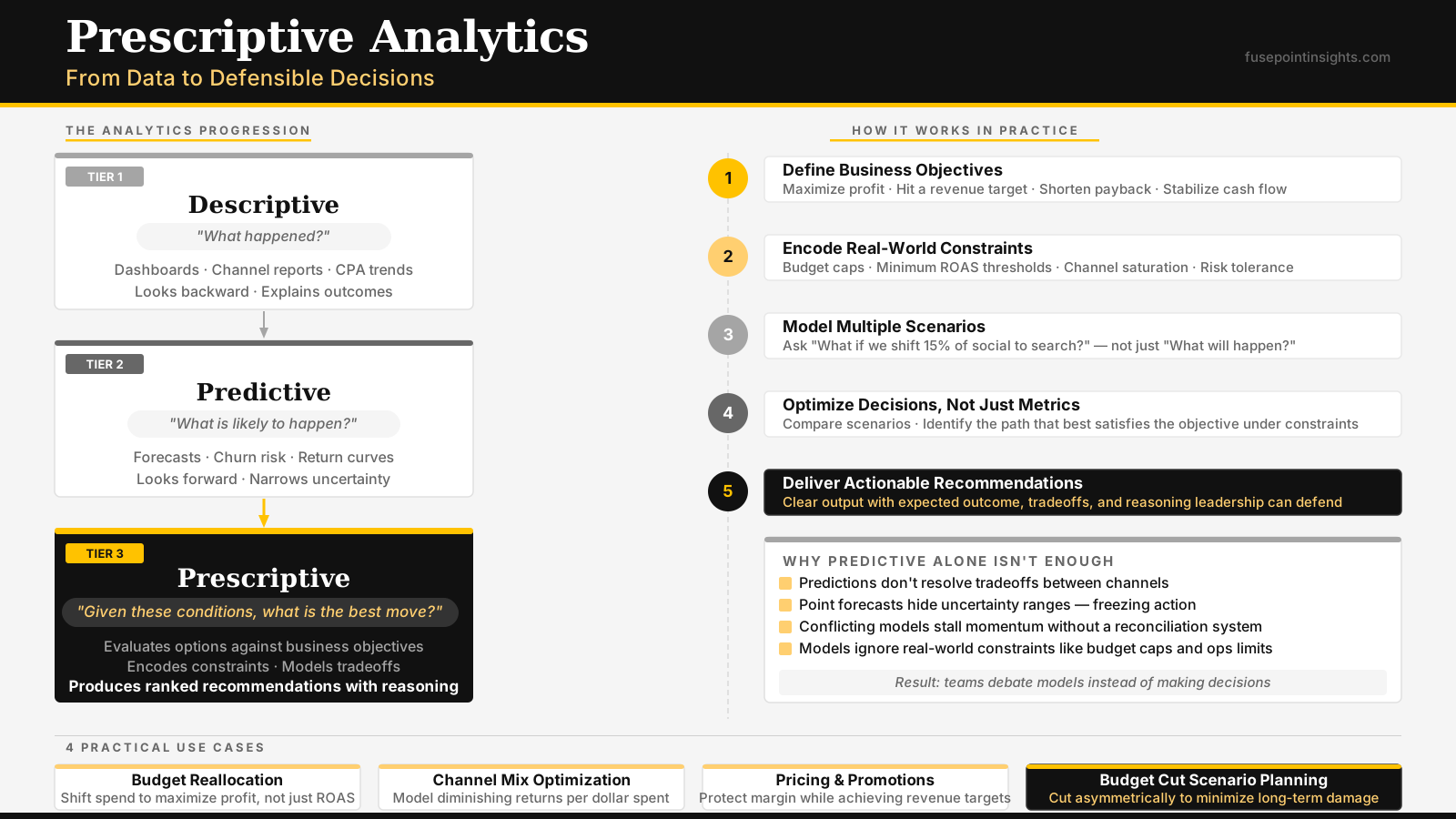
Predictions don’t resolve tradeoffs
A predictive model might say paid search will return a 3.1x ROAS, paid social 2.6x, and CTV 2.2x. That information alone doesn’t tell you where the next dollar should go.
-
What if search is already saturated?
-
What if social has more variance but a stronger upside?
-
What if CTV drives downstream lift that doesn’t show up in the short-term forecast?
Clearly, predictions describe outcomes in isolation.
Uncertainty freezes action
Most forecasts are point estimates. They hide risk.
A channel projected to deliver 3.0x ROAS could range from 1.8x to 4.2x. Without understanding that range, executives either over-trust the number or discount it entirely.
When uncertainty isn’t made explicit, teams default to safer, familiar choices, even if better options exist.
Conflicting predictions stall momentum
It’s common for different models to disagree.
Each model may be technically correct within its own framework, but without a system to reconcile them, the organization debates models instead of making decisions.
Predictions ignore real-world constraints
Predictive models don’t know that you can’t increase spend by more than 10% this quarter, or that your ops team can’t support another acquisition surge.
Without accounting for these constraints, predictions remain academically interesting but operationally unusable. Teams fall back on gut instinct or static rules like “Never exceed last quarter’s spend by more than X.”
How prescriptive analytics works in practice
To answer the question, “What should we do next, given our goals, constraints, and tradeoffs?”, predictive analytics starts by operationalizing your predictions.
Start with business objectives
Prescriptive systems begin with a clear objective, be it:
-
Maximizing profit
-
Hitting a revenue target with controlled risk
-
Shortening payback
-
Stabilizing cash flow
For example, a retail brand heading into peak season may prioritize margin protection over top-line growth. A subscription business may prioritize retention efficiency over acquisition volume.
The objective defines what “best” actually means.
Encode constraints explicitly
Real decisions operate within limits, such as
-
Fixed or capped budgets
-
Minimum ROAS or payback thresholds
-
Channel capacity or saturation
-
Risk tolerance (for example, downside exposure limits)
By encoding these upfront, recommendations reflect reality instead of idealized outcomes.
Model scenarios, not single forecasts
Rather than asking “What will happen?”, prescriptive systems ask questions like:
-
What if we reallocate 15% of paid social spend to search?
-
What if we cap prospecting and increase retention investment?
-
What if we accept a lower short-term ROAS in exchange for higher lifetime value?
Optimize decisions, not metrics
Prescriptive logic compares scenarios and identifies the action that best satisfies the objective under constraints.
That might mean:
-
Allocating incremental budget to a lower-ROAS channel because it reduces volatility
-
Holding spend steady despite a positive forecast because marginal returns are deteriorating
-
Prioritizing fewer customers with higher expected lifetime profit
Deliver recommendations that leadership can act on
Ultimately, the output of prescriptive analytics is a recommendation with reasoning. This can look like: “Shift 10% of spend from prospecting social to branded search. Expected outcome: slightly lower conversion volume, higher margin stability, and faster payback within current risk limits.”
That clarity is what turns analytics into action.
Prescriptive analytics gives the team a structured, defensible way to make better decisions, especially when the data is messy and the stakes are high.
Practical prescriptive analytics use cases in marketing and growth
When used well, prescriptive analytics helps leaders choose between real options.
Reallocating media budgets across channels
A growth team enters Q3 with a fixed budget. Through media mix modeling, they find that paid search is reliable but saturated, and paid social shows volatility. Upper-funnel channels look weak on last-click attribution but strong in long-term models.
Based on this information:
-
Descriptive analytics reports performance by channel.
-
Predictive analytics forecasts returns if spending remains unchanged.
Prescriptive analytics goes further. It evaluates multiple allocation scenarios (e.g., shifting 10% from search to video or reducing social spend) and recommends the mix that maximizes profit. If you’re looking to maximize ROI through strategic budget allocation, explore fusepoint’s media planning services.
Optimizing channel mix under diminishing returns
Prescriptive analytics models diminish returns explicitly. Instead of assuming every additional dollar behaves like the last, it evaluates where marginal returns fall below acceptable thresholds.
Pricing and promotion decisions
Pricing teams often rely on historical elasticity or past promotions. Prescriptive analytics reframes the decision.
Consider this example: A DTC brand considering a 20% sitewide discount runs scenarios comparing smaller targeted offers, free shipping thresholds, and loyalty-only promotions. Prescriptive analytics recommends the option that preserves margin while achieving revenue targets, which is often not the biggest discount.
The recommendation accounts for trade-offs between short-term volume and long-term customer value.
Scenario planning under budget changes
When budgets tighten, most teams cut evenly or protect “proven” channels. Prescriptive analytics handles cuts asymmetrically.
For instance, a SaaS company facing a 15% budget reduction uses prescriptive modeling to evaluate which spend reductions cause the least long-term damage. The model might recommend reducing prospecting spend in low-LTV segments while protecting mid-funnel investment supporting renewals.
The common thread across these use cases is choice. Prescriptive analytics doesn’t present a single forecast and expect leadership to agree on it. It compares paths: If we do this, here’s the outcome. If we do that, here’s the tradeoff.
Ultimately, it turns analytics into a system for making better decisions.
Prescriptive analytics is a system, not a tool
Prescriptive analytics is the result of a system designed to support decisions under real constraints. When used well, it sits at the intersection of measurement, experimentation, and business logic.
Importantly:
-
It depends on clean, connected data.
-
It requires consistent assumptions about value, cost, and risk.
-
It only works when leadership aligns on what the business is optimizing for.
This is why most organizations struggle to operationalize prescriptive analytics. They have predictions, but without testable assumptions and traceable logic, “recommended actions” never actually get implemented.
fusepoint does things differently, approaching prescriptive analytics as an extension of how decisions actually get made.
Even with past and future knowledge, if your organization debates what to do next, the gap lies in its decision logic. Marketing performance measurement consulting with fusepoint can help close that gap.
Sources:
ScienceDirect. Prescriptive analytics: Literature review and research challenges. https://www.sciencedirect.com/science/article/pii/S0268401218309873
IBM. What is prescriptive analytics? https://www.ibm.com/think/topics/prescriptive-analytics
PubMed Central. Machine Learning for Predictive and Prescriptive Analytics of Operational Data in Smart Manufacturing. https://pmc.ncbi.nlm.nih.gov/articles/PMC7225513/
Taylor & Francis Online. Artificial intelligence and prescriptive analytics for supply chain resilience: a systematic literature review and research agenda. https://www.tandfonline.com/doi/full/10.1080/00207543.2024.2341415
Our Editorial Standards
Reviewed for Accuracy
Every piece is fact-checked for precision.
Up-to-Date Research
We reflect the latest trends and insights.
Credible References
Backed by trusted industry sources.
Actionable & Insight-Driven
Strategic takeaways for real results.
Emily Sullivan is an experienced marketing professional with over a decade of expertise in content creation, communications, and digital strategy. She thrives on translating complex, technical subject matter into content that is approachable, insightful, and genuinely useful to marketing professionals navigating a fast-evolving landscape.