




Data clean rooms explained: Definition, use cases, and why they matter for marketing measurement

Emily Sullivan is an experienced marketing professional with over a decade of expertise in content creation, communications, and digital strategy. She thrives on translating complex, technical subject matter into content that is approachable, insightful, and genuinely useful to marketing professionals navigating a fast-evolving landscape.

Scott Zakrajsek is a data-driven marketing executive with over 15 years of experience leading digital transformation for iconic brands. As Head of Data Intelligence at fusepoint and Power Digital, he specializes in turning complex data ecosystems into actionable strategies that drive growth.

- 1. What is a data clean room?
- 2. How does a data clean room work?
- 3. Use cases for data clean rooms in marketing
- 4. Why data clean rooms matter in a privacy-first world
- 5. Limitations and misconceptions about data clean rooms
- 6. How fusepoint uses data clean rooms to enable better, safer marketing decisions

Imagine trying to solve a puzzle with someone else, but neither of you is allowed to show your pieces to the other. You can’t pass them across the table, you can’t copy them, and you can’t even describe them in detail. All you’re allowed to do is agree on the rules of the game and compare what fits when pieces are placed together.
That’s essentially the data clean room meaning.
As privacy restrictions tighten and third-party identifiers disappear, brands and platforms still need a way to understand overlap, reach, and impact, without exposing raw user data. Data clean rooms provide a controlled environment. They allow multiple parties to analyze shared datasets and generate insights while keeping underlying customer information sealed off.
As a marketing measurement consultancy, fusepoint believes this is more important than ever. Clean rooms make collaboration possible in a world where data cannot move freely. When used correctly, they become a critical bridge between privacy, performance, and business truth.
What is a data clean room?
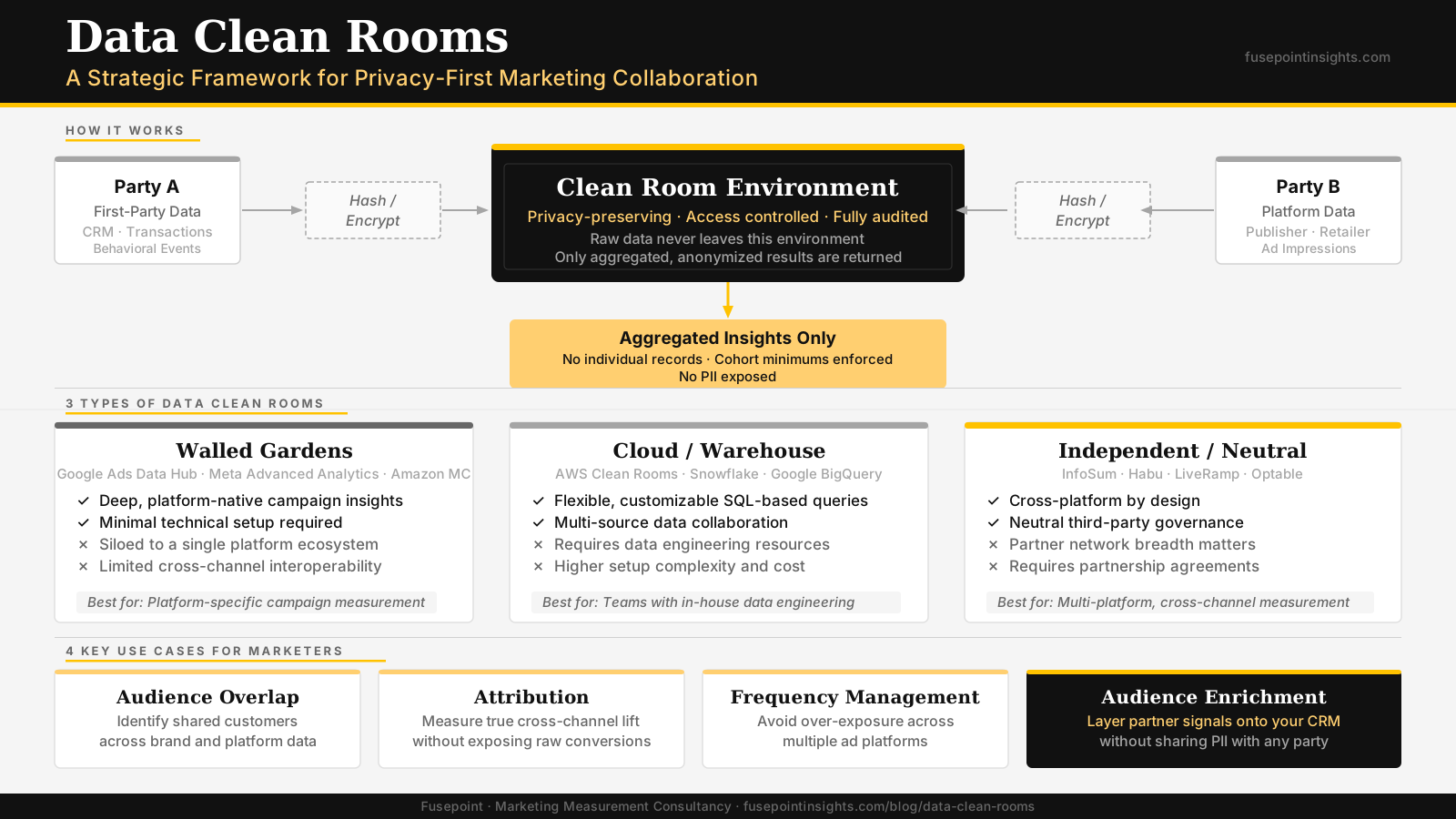
A data clean room is a secure, privacy-preserving environment where multiple parties can analyze combined datasets without exposing raw, identifiable data to one another.
In practical terms, the data clean room definition is simple: Marketers get to answer questions that require shared data (like “how many of our users also shop with Retailer X?” or “what’s the true incremental value of this campaign across platforms?”) without any party giving away raw customer data, PII, or proprietary business information.
Instead of handing over spreadsheets of user emails, a clean room lets each party bring their own data, match at scale in a privacy-preserving way, and run analyses together. Only aggregated, anonymized results leave the environment.
For marketing teams, understanding “What is a data clean room?” addresses a core tension: You need integrated measurement to understand consumer journeys and media impact, but privacy regulations (such as GDPR and CCPA) and platform restrictions limit how much identifiable data can be shared. Clean rooms let teams work around that without violating privacy or legal constraints.
How does a data clean room work?
To answer “how does a data clean room work?”, compare it to a laboratory with strict protocols where experiments happen, but the raw ingredients never leave the lab.
Anonymization and hashing
Parties often hash or tokenize identifiers (like customer IDs or email hashes) before ingesting data. This means the clean room only sees hashed keys that are consistent across parties but meaningless on their own.
Aggregation and thresholds
Queries in clean rooms typically return only aggregated results, and individual records are never exposed. Many clean rooms also enforce minimum thresholds (for example, only return results for cohorts larger than 50) to prevent re-identification.
Permissions and governance
Access controls ensure that only approved analyses are permitted. A marketer can query “unique conversions by channel across datasets,” but cannot list individual-level rows or export raw matches.
Query-based access
Users write or select queries. The clean room runs them against combined datasets. The environment vets results on privacy constraints before returning them.
Clean rooms vary in implementation. Some run on cloud platforms (AWS, Snowflake), and some are offered by the platforms themselves (e.g., Google or Meta). However, the principles are consistent: No one sees another party’s raw data, and only aggregated insights are shared.
This means clean rooms are environments, not datasets. They enable privacy-preserving collaboration across datasets without exposing proprietary information.
Use cases for data clean rooms in marketing
Data clean rooms are especially useful where measurement depends on linking data from two or more sources.
Publisher and advertiser measurement
Marketers often want to know how their campaign performed inside a platform versus across the rest of the ecosystem.
For example, a CPG brand may run TV and digital campaigns and want to estimate cross-channel uplift. Historically, they might only see platform-specific results (such as clicks and conversions). A clean room lets the brand combine advertiser data with publisher logs to measure incremental lift across both views.
This solves the problem of siloed measurement. Instead of saying “Meta reports that I got 10k conversions,” the brand can answer: How many of those conversions from meta were incremental when we include search, retail footfall, and owned CRM behavior?
Retail media and platform collaboration
Retail media networks (like Walmart, Kroger, and Target) often have first-party purchase data. Advertisers have CRM, site behavior, and loyalty data. Clean rooms let these datasets be combined to answer questions like:
-
How many purchases were driven incrementally by a specific retail media campaign?
-
What is the total revenue impact when both first-party and retail first-party data are considered together?
Through retail media measurement, these analyses support budget decisions and bidding strategies based on true combined performance, not fragmented views.
Cross-channel reach and frequency analysis
After campaigns, marketers often want to know:
-
Effective reach (how many unique users saw a brand across channels).
-
Frequency (how often they saw it).
However, platforms report these data differently and often can’t share cross-platform IDs due to privacy constraints.
Clean rooms enable teams to link hashed IDs across sources to measure real reach curves without exposing individual identities. As a result, teams can invest in the channels where incremental reach is highest, instead of buying more impressions that may be duplicates.
Incrementality and lift studies
Incrementality testing aims to answer: Did this campaign cause the outcome, or just correlate with it? Clean rooms enable marketers to conduct multi-source lift analysis by aligning advertiser exposure data with downstream outcomes in aggregate.
For instance, a brand might test a holdout in advertising spend in certain DMAs. By bringing spend data and sales outcomes into a clean room, they can measure lift without exposing raw customer data. The output is causal, business-grade insight, not just platform-attributed conversions.
This ties directly to business decisions: should we scale this tactic, pause it, or reallocate budget?
Privacy-safe audience overlap analysis
Understanding audience overlap across platforms is critical to avoiding wasted spend. Without data clean rooms, marketers see overlap only through incomplete attribution pixels or platform proxies.
Data clean rooms calculate overlap at scale in a privacy-safe way. For example:
-
What portion of my CRM audience is also reachable via Retailer A’s media network?
-
Which segments are truly unique to a given channel?
This informs audience strategy, frequency caps, and duplication control, all of which are crucial to efficient spend.
Why data clean rooms matter in a privacy-first world
Marketing performance measurement changed the moment third-party identifiers became unreliable. Beyond limiting targeting, cookie deprecation, platform privacy controls, and tighter regulation have broken many of the foundational assumptions on which measurement systems were built.
According to Deloitte, over 90% of consumers say data privacy is now a top priority when interacting with businesses. At the same time, marketers still need to collaborate across platforms, publishers, retailers, and partners to understand performance.
That tension is why data clean rooms exist.
Clean rooms enable organizations to collaborate without sharing raw customer data. They enforce governance by design: who can query what, at what level of aggregation, and with what safeguards. Now, partners can collaborate without risking data leakage, misuse, or downstream exposure.
What data clean rooms do not do is replace strategy, analytics, or judgment. In other words, they don’t tell you what questions to ask; they simply make it possible to ask questions that would otherwise be unsafe or impossible.
Limitations and misconceptions about data clean rooms
Before you start using data clean rooms, a few clarifications are important to note.
Clean rooms do not generate insights automatically
They provide a controlled environment, but insight still depends on data quality, model design, and interpretation.
Poor logic inside a clean room will still produce poor results.
Clean rooms do not solve attribution on their own
They can enable better attribution inputs, but they do not determine causality. Without incrementality testing or modeling, clean room outputs remain descriptive.
Clean rooms do not replace MMM, experimentation, or analytics teams.
Clean rooms are infrastructure, not intelligence.
This is where many tool vendors fall short. They provide access to a secure environment, but stop there, leaving teams without the analytical framework, validation methods, or business context required to turn clean room outputs into decisions.
Without strong measurement frameworks, clean rooms risk becoming expensive query layers that surface correlations without context.
How fusepoint uses data clean rooms to enable better, safer marketing decisions
Clean rooms are most valuable when they’re part of a broader measurement system.
-
In incrementality testing, clean rooms enable advertisers and publishers to align exposure and outcome data securely.
-
In Media Mix Modeling, clean rooms can provide calibrated inputs (such as validated reach, frequency, or overlap metrics) that improve model realism, especially as user-level data becomes less available.
-
In unified measurement frameworks, clean rooms allow disparate datasets to be analyzed under consistent logic while preserving privacy constraints.
Importantly, clean rooms also enable iteration. As new experiments run or models are updated, the same governing environment can be reused.
At fusepoint, data clean rooms are inputs to a broader measurement system. If your efforts are generating answers but not changing how you allocate spend, forecast growth, or assess risk, the problem is integration.
fusepoint’s data intelligence consulting partners with teams to turn data clean rooms into durable measurement systems that scale. Reach out today to learn how.
Sources:
International Data Corporation. Data Clean Rooms: Secure and Private Data Collaboration. https://www.idc.com/resource-center/blog/data-clean-rooms-secure-and-private-data-collaboration/
European Commission. D2.2 Federated Data analysis Architecture – Part 2. https://ec.europa.eu/research/participants/documents/downloadPublic?documentIds=080166e51ad8ddde&appId=PPGMS
Nature.com. A comprehensive survey on securing the social internet of things: protocols, threat mitigation, technological integrations, tools, and performance metrics. https://www.nature.com/articles/s41598-025-23865-4
Gartner. Best Data Clean Rooms Review 2026. https://www.gartner.com/reviews/market/data-clean-rooms
McKinsey & Company. The State of Grocery Retail 2022: Europe – McKinsey. https://www.mckinsey.com/~/media/mckinsey/industries/retail/our%20insights/state%20of%20grocery%20europe%202022/navigating-the-market-headwinds-the-state-of-grocery-retail-2022-europe.pdf
Deloitte. New Deloitte Survey: Increasing Consumer Privacy and Security Concerns in the Generative AI Era. https://www.deloitte.com/us/en/about/press-room/increasing-consumer-privacy-and-security-concerns-in-the-generative-ai-era.html
Our Editorial Standards
Reviewed for Accuracy
Every piece is fact-checked for precision.
Up-to-Date Research
We reflect the latest trends and insights.
Credible References
Backed by trusted industry sources.
Actionable & Insight-Driven
Strategic takeaways for real results.
Emily Sullivan is an experienced marketing professional with over a decade of expertise in content creation, communications, and digital strategy. She thrives on translating complex, technical subject matter into content that is approachable, insightful, and genuinely useful to marketing professionals navigating a fast-evolving landscape.