




How Advertising Halo Effects in MMM Can Mislead Your Media Strategy

Emily Sullivan is an experienced marketing professional with over a decade of expertise in content creation, communications, and digital strategy. She thrives on translating complex, technical subject matter into content that is approachable, insightful, and genuinely useful to marketing professionals navigating a fast-evolving landscape.

- 1. What is the halo effect in advertising?
- 2. Common examples of the halo effect in media
- 3. How the halo effect can mislead marketing mix models
- 4. How to detect halo effects in MMM
- 5. Modeling halo effects correctly
- 6. Connecting halo measurement with incrementality testing
- 7. Seeing the full picture in media measurement with fusepoint

Consider this common scenario: A brand increases ad spend and experiences either a dip in online revenue or online revenue remains flat. On paper, that additional ad spend seems to be a waste. Dashboards indicate a low ROAS, and leadership starts telling you your annual budget is going to get cut due to the lack of return.
But in that same time frame and the weeks that follow, the brand reports unexpected lifts and branded search demand increases on Amazon, none of this makes sense in the platform numbers the team is optimizing against, because nothing within their strategy changed.
This is the halo effect: advertising that drives value far beyond the channel or vertical where the conversion is tracked. And while it’s good news for the business, it creates a real problem for measurement. That’s because traditional MMMs often bundle success or failure with the wrong channels or factors, leading teams to over-credit some tactics and underinvest in the ones that are actually driving lift.
The result is a strategy that looks efficient on paper but misallocates spending in practice. To help you avoid this, we’re breaking down how marketing teams can build an effective measurement system to capture the real impact of their media.
What is the halo effect in advertising?
In multi-channel marketing, the halo effect occurs when exposure in one channel influences performance or perception in another channel, often without being directly noticeable. On the one hand, it’s a powerful signal of brand influence; on the other, it can distort measurement and mislead strategy.
How the halo effect in advertising and media shows up
A national TV brand campaign may never generate a direct click, but in the weeks or months following its run, organic search volume may spike. Those downstream gains may be driven by the campaign’s brand lift rather than direct attribution.
In Marketing Mix Modeling (MMM), this can appear as unexplained co-movement between channels: channel A’s spend increases and channel B’s performance improves simultaneously. This is not because B got more spend, but because the campaign that activated channel A created lift for channel B.
Why traditional models struggle with the halo effect
Traditional MMM often treats each channel’s coefficient as independent and fixed. That ignores the spill-over:
-
A channel may receive undue credit simply because it co-occurred with the spill from another channel.
-
The model may undercount the indirect value of channels (such as brand or upper-funnel activity) that don’t tie neatly to a click or conversion.
The same logic applies here as above: A campaign in Channel X drives lift across Channel Y, but unless measured, Channel Y may look like it performed on its own.
Common examples of the halo effect in media
The halo effect in advertising is evident in everyday campaigns across various categories. Unless it is explicitly measured, it can warp how MMM assigns credit.
How the halo effect can mislead marketing mix models
Halo effects become dangerous when MMM treats each channel as if it operates in isolation. And this is common. In fact, most traditional models assume independence: Spend in Channel A drives its own conversions, just as Channel B drives its own.
However, in a real marketing system, channels influence one another constantly.
Overestimating ROI in channels that simply capture demand
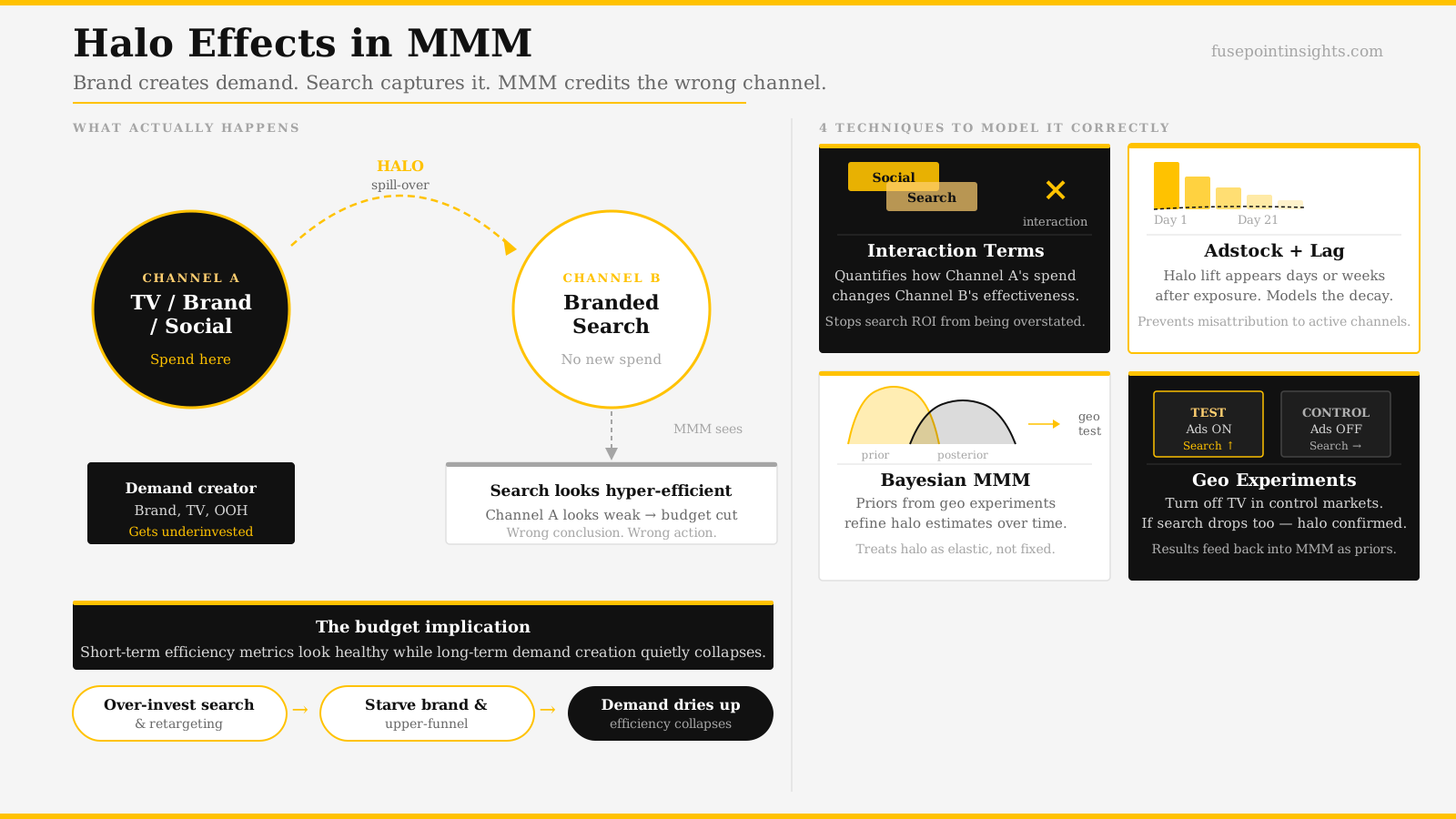
If a brand campaign drives more branded search, MMM may assign that uplift to search because it appears most closely connected to the conversion. Search then looks hyper-efficient, even though it didn’t create the demand; it just captured it.
This inflates elasticity estimates and directs future marketing budgets toward the wrong place.
Underestimating the true incremental driver
Meanwhile, the channel that generated the halo (TV, influencers, upper-funnel social) ends up looking weak or inefficient. Without modeling the cross-channel influence, MMM underestimates key demand-creation tactics and overestimates the channels that actually generate interest.
Misallocating budgets and cannibalizing long-term growth
Over time, this mismatch pushes dollars into “last-touch” channels and starves upper-funnel investments. The result is short-term efficiency at the expense of long-term demand.
How to detect halo effects in MMM
Identifying halo effects requires looking for where influence hides. Ultimately, effective diagnostics will blend statistical analysis with experimentation.
Here’s how you can do just that:
-
Analyze cross-channel correlations and lagged relationships
-
- If paid social spend spikes followed by a two-day delayed lift in branded search traffic, that’s a halo signature.
- Lagged correlation tests and impulse–response analysis will help you reveal these delayed impacts.
-
-
Run incrementality experiments or geo tests
-
- Incrementality experiments are the gold standard for detecting halo effects in marketing mix modeling.
- For example, turning off TV media in a control region and measuring whether search volume drops will isolate true causal lift. These results can be used to refine MMM priors.
-
-
Track baseline shifts in related KPIs
-
- When a big campaign launches, look beyond the channel where the budget was deployed. If direct traffic, search demand, or retail sales rise together, the uplift is likely to originate from a cross-channel halo, rather than isolated channel performance.
-
-
Review time-series co-movement among related channels
-
- If two channels spike or flatten in tandem despite only one receiving spend, your MMM is probably attributing shared movement to the wrong place. Co-movement without shared spend is a red flag that halo influence is being misassigned.
- With halo detection strategies, your team can make data-informed budget decisions that reflect how your marketing actually works.
-
Modeling halo effects correctly
Advanced MMM models treat the halo effect in media as a structural feature of the system, using techniques that separate true incremental influence from surface-level correlation.
Cross-channel interaction terms
Interaction terms allow the model to reflect scenarios where spending in one channel changes the effectiveness of another.
For example, if paid social increases branded search demand, a “social × search” interaction term quantifies how much search performance depends on social activity.
This prevents search ROI from being overstated and accurately assigns credit to the driver.
Adstock and lag structures to capture delayed effects
Halo effects often show up days or weeks after exposure, especially for channels like CTV, influencers, or OOH.
Fortunately, adstock transforms and lag structures account for:
-
Gradual decay of attention
-
How long awareness persists
-
When downstream channels capture the demand
Without these, traditional MMMs will misattribute delayed lift to whatever channel happens to be active that week.
Bayesian MMM to quantify uncertainty and refine assumptions
Bayesian models are particularly well-suited for halo modeling because they use probability distributions, not rigid point estimates.
Importantly, they can incorporate priors from:
-
Past campaigns
-
Geo experiments
-
Industry benchmarks
-
Elasticity studies
These priors help the model treat halo effects as elastic, evolving relationships rather than fixed coefficients.
Experimental validation to ground the math in reality
Even the best statistical model needs real-world validation. Geo-split tests, holdout tests, or platform lift studies offer independent proof of whether halo assumptions reflect actual incremental lift.
The outputs of these tests then feed back into the model, tightening priors and sharpening halo estimates over time.
Connecting halo measurement with incrementality testing
Modeling halo effects is only half the job. The other half is proving they’re real. MMMs can suggest relationships between channels, but without experimental validation, it’s impossible to know whether a lift is genuinely causal or just a convenient correlation.
This is where incrementality testing comes in.
-
Geo experiments expose halo effects by isolating markets. If a brand campaign runs in treatment regions only, but branded search, retail sales, or email revenue rise in those same regions, you’ve captured measurable halo lift. When those downstream metrics rise in sync with the campaign, it verifies whether the MMM’s halo assumptions are directionally correct.
-
Lag and decay testing strengthens the calibration by analyzing how long the downstream lift persists after treatment ends. This prevents models from “stretching” halo effects longer than the market actually supports.
fusepoint integrates these experimental reads directly into the modeling loop. When both systems agree (the model and the experiment), you get a measurement framework that leaders can actually trust for budget allocation and long-term planning.
Seeing the full picture in media measurement with fusepoint
When halo effects aren’t measured, they distort everything downstream, including ROI, budget allocation, and the narrative leaders use to justify investment. Over time, the business may grow, but not efficiently or with the clarity needed to scale.
fusepoint helps brands break this cycle. That’s because we build measurement systems that account for the full chain of influence, not just the touchpoints that are easy to track. Our approach blends halo-aware MMM, incrementality testing, and finance-grade diagnostics to show exactly where lift is coming from. It’s how we’ve helped our clients generate over $2 billion in revenue and grow 2.6x faster than the market standard.
If you’re ready to see the entire picture of your media impact, not just the visible fragments, partner with a marketing science company like fusepoint and create a measurement system that’s truly decision-ready. Reach out today to book a strategy call and learn more.
Sources:
McKinsey & Company. From myth to math: Harnessing the halo effect of promotions. https://www.mckinsey.com/capabilities/growth-marketing-and-sales/solutions/periscope/our-insights/articles/~/media/257314199D824FCF923EBD127DA527F8.ashx
Amsive. When Paid Media Goes Dark: A Halo Effect Case Study. https://www.amsive.com/insights/digital-media/when-paid-media-goes-dark-a-halo-effect-case-study/
EBSCO. The Halo Effect in Small Enterprises’ Marketing. https://openurl.ebsco.com/EPDB%3Agcd%3A1%3A20964433/detailv2?sid=ebsco%3Aplink%3Ascholar&id=ebsco%3Agcd%3A141187499&crl=c&link_origin=scholar.google.com
Our Editorial Standards
Reviewed for Accuracy
Every piece is fact-checked for precision.
Up-to-Date Research
We reflect the latest trends and insights.
Credible References
Backed by trusted industry sources.
Actionable & Insight-Driven
Strategic takeaways for real results.
Emily Sullivan is an experienced marketing professional with over a decade of expertise in content creation, communications, and digital strategy. She thrives on translating complex, technical subject matter into content that is approachable, insightful, and genuinely useful to marketing professionals navigating a fast-evolving landscape.