




Understanding Adstock in Media Mix Modeling

Emily Sullivan is an experienced marketing professional with over a decade of expertise in content creation, communications, and digital strategy. She thrives on translating complex, technical subject matter into content that is approachable, insightful, and genuinely useful to marketing professionals navigating a fast-evolving landscape.

Ben Dutter is Chief Strategy Officer at Power Digital and founder of fusepoint, a data and strategy consultancy powered by deep marketing intelligence. He’s spent nearly 20 years driving growth for brands like Amazon, Crocs, and Liquid Death, with a focus on ethical, effective, data-driven marketing.


When you come up with a stellar idea for a campaign, you don’t want it to be a flash in the pan. You want it to make a mark. To last.
The concept you’re looking for, then, is adstock. Maybe you’ve already heard the term but aren’t quite sure what it means—or why it matters.
So, let’s clear it up: Adstock measures the lingering effect of your marketing efforts. And when you’re viewing your marketing through a media mix modeling (MMM) lens, adstock is a crucial part of clarifying ROI. By including adstock in market mix modeling, you can understand where you came from and where you’re headed.
What is Adstock?
Adstock involves modeling the cumulative, long-term impacts of your marketing. It goes beyond the initial exposure period—when the clickthroughs are rolling in and the conversion rate climbs—to focus on the time during and after a campaign.
Adstock is worth considering because it represents the difference between a good campaign and a great one. Just think back to the most memorable ads from your lifetime. They probably haven’t run for years, and yet, you still remember them.
That’s adstock at work. It’s proof that not all advertising impacts happen immediately; influence can linger, decay, and even accumulate over time.
How Adstock relates to MMM
Now that you’re clear on adstock, we can turn to the bigger picture: What is adstock in MMM?
Media mix modeling, as you probably know, is about analyzing historical data to determine ad effectiveness across channels. It looks back in hopes of understanding what’s working now.
Adstock goes a step further, fashioning all of your past and present insights into a telescope that can gaze into the future. What it helps marketers see is that every new campaign builds on the last.
When utilized correctly, adstock empowers brands to mathematically adjust their media inputs, keeping longevity and lasting brand awareness top of mind.
Why adstock is essential for accurate MMM results
You can probably see the problem with a traditional, no-adstock approach to MMM: It assumes that advertising stops influencing consumer behavior the second spending ends. And that’s simply not true.
In reality, marketing campaigns (the winning ones, at least) endure long after your last cent is spent. Strong ads live rent-free, as they say, in the consumer’s head.
If you ignore adstock in your MMM, you’re underestimating the effectiveness of your advertising. That mistake can lead to inaccurate reporting, overspending, and the misallocation of funds.
If you include adstock in your MMM, you can:
-
Capture the carryover effect – Campaigns continue to exert influence after ending, even if it’s subliminal. In fact, brand awareness campaigns are a perfect example of the carryover effect. They’re designed to have a long-term impact on shopping habits.
-
Account for delayed consumer responses – While some purchases are impulse buys, others call for days of consideration and multiple exposures. Even if a hesitant customer buys your product a week after the campaign ends, they were still influenced by your ads, right? Adstock accounts for this delayed sale; traditional MMM does not.
-
Improve modeling for saturation and diminishing returns – Adstock also helps you avoid overexposure. If you notice that your advertising effectiveness is slowing down, you might want to reduce your future ad frequency.
Ultimately, adstock in MMM provides clearer insights into the lingering effects of your marketing, making ROI calculations more realistic and actionable.
How adstock works in practice
In theory, incorporating adstock into your MMM is a no-brainer. But what does that look like in practice?
Mathematically speaking, there are three concepts to consider:
-
The lag effect
-
The decay rate
-
Transformation
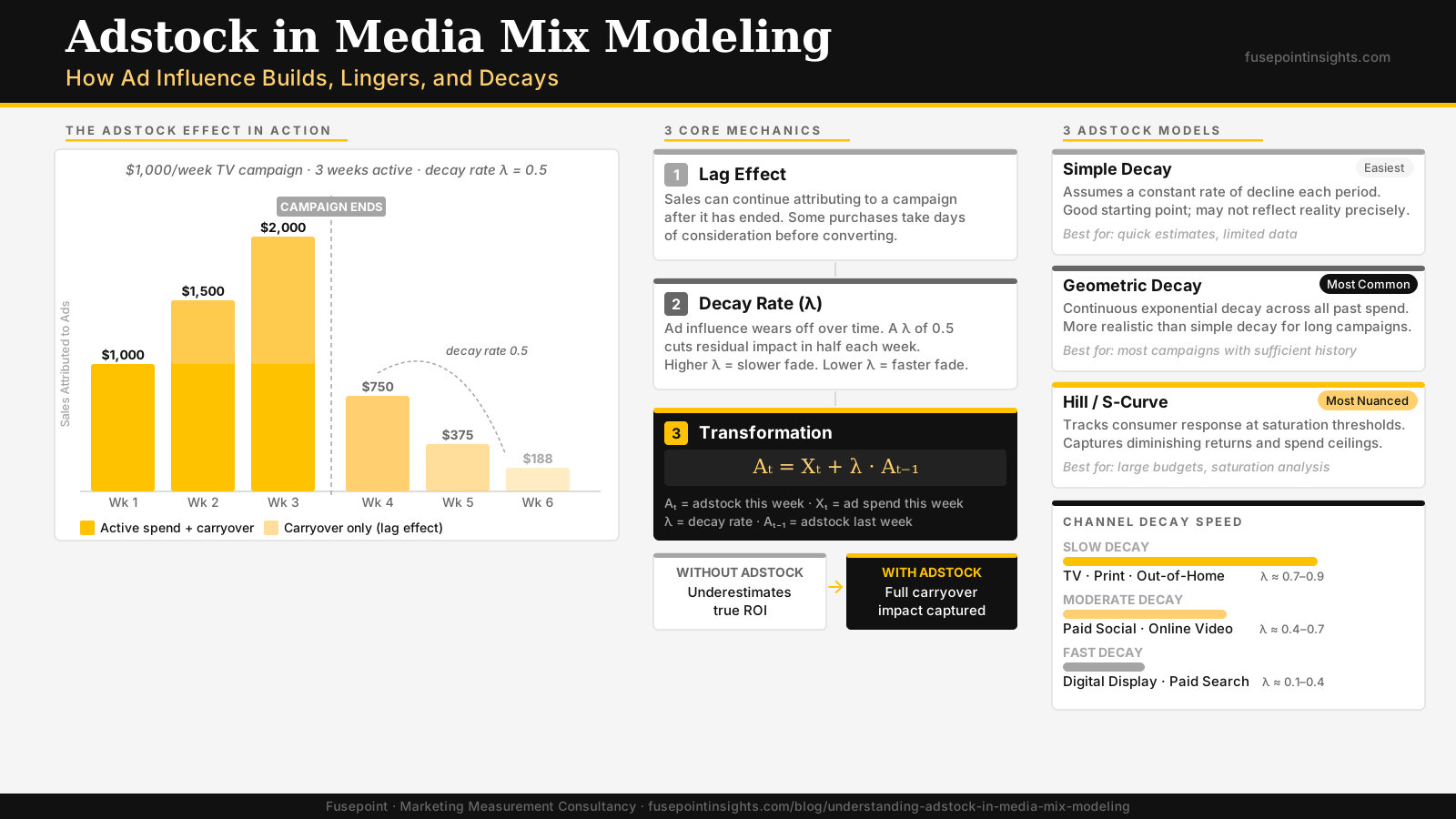
To illustrate these concepts in action, we’ll use a fictional CPG brand. Imagine that XYZ Brand runs a three-week TV spot for a brand awareness campaign, spending $1,000 per week.
1. The lag effect
Because advertising continues to drive impact after exposure ends, some sales will inevitably lag behind the campaign’s active period.
Let’s say that, in Week 4 (after the TV spot ends), XYZ Brand does $750 in sales. Those delayed sales can be attributed to the TV ads, thanks to the lag effect.
Interestingly, the lag effect also applies when the campaign is still running. Imagine that Week 2’s sales are $1,500, and Week 3’s sales reach $2,000. The ROI for Week 3 is higher because the lagging influence from Weeks 1 and 2 is also captured.
2. The decay rate
Although marketing efforts can compound over time, they won’t last forever. Eventually, the influence of advertising wears off. That’s the decay rate.
Imagine that our example brand can attribute the following sales to its TV campaign:
-
Week 4: $750
-
Week 5: $375
-
Week 6: $187.50
While your numbers won’t always be this clean, you can see the pattern: Each week, sales are cut in half, giving us a decay rate of 0.5. The higher the decay rate, the faster your ad influence fades.
3. Transformation
When you put it all together, you get an equation that “transforms” raw ad spend into an adjusted variable that reflects your real ad influence. If you have a simple, unchanging decay rate, the formula looks like this:
At = Xt + λAt−1
Here’s what to plug in:
-
t is the current week
-
A is the value of your adstock in week t
-
X is the value of the ad spend in week t
-
λ is the decay rate
Seems complicated? It can be—especially if you don’t have the right data intelligence company, or an experienced team, behind you. For now, remember that adstock helps calculate the extended effects of your marketing efforts with more accuracy.
Common adstock models used in MMM
Now, there are several ways to view the buildup and decay of your ad spend. The three most common approaches used by analysts to apply adstock are:
-
Simple decay model – This is the formula above. It assumes a constant rate of decline over time. Because reality isn’t so mathematically perfect, this approach may not be 100% accurate, but it’s the simplest way to estimate adstock.
-
Geometric decay model – This is the most common approach, modeling a continuous exponential decay in marketing influence. Translation: It accounts for the sum of all past ad spend, rather than breaking things down week by week.
-
Hill or S-curve transformations – This approach sets aside lag and decay in favor of tracking consumer response levels. It helps capture both saturation levels and signs of diminishing returns, indicating when ad spending needs to change.
All three models have their uses. Your best option will depend on data volume, channel type, and campaign duration.
Interpreting adstock results and applying insights
Put simply, when you understand adstock, you can make smarter marketing decisions.
For instance, with an adstock-adjusted analysis, you can:
-
Determine the optimal timing and frequency of your ads
-
Gauge the effectiveness of always-on vs. short-burst campaigns
-
Prove the lasting value of upper-funnel investment
-
Bridge short-term and long-term measurement
-
Ensure performance and brand-building activities are reflected in ROI models
Of course, to do all that, you have to truly understand the adstock effect. If you’re not as mathematically minded, consider a marketer-analyst collaboration during the planning phase.
Analysts can help fit adstock into increasingly complex MMM frameworks that include geo experiments, digital attribution, and machine learning (ML). From calculating adstock by region to learning about customer journeys at the individual level, an in-depth adstock + MMM analysis offers unparalleled insights.
Challenges and best practices for modeling adstock
If you are planning to tackle adstock yourself, you should know what you’re up against. Some of the biggest challenges of incorporating adstock include:
-
Choosing the appropriate decay rate – Without a program or past experience to help calculate the decay rate, you’re stuck making semi-educated guesses.
-
Overfitting the model with incorrect assumptions – Whether it’s the decay rate or the adstock value, you can’t assume anything. You need accurate numbers.
-
Understanding differences across channels – The adstock effect plays out differently on TV, search, and social media.
To overcome these pitfalls, turn to our tried-and-true adstock best practices:
-
Test multiple decay scenarios – For a reasonable ballpark guess, you can work backward by using different decay rates. Try the equation with λ = 0.8. Not quite right? See if 0.5 does the trick. Testing is the best way to learn the true longevity of your marketing.
-
Use domain knowledge to calibrate parameters – Learn more about each channel. Understand that TV can linger longer, while digital display ads tend to fade faster.
-
Validate results with external benchmarks – Use results from past campaigns or other brands’ successes to see how your efforts stack up. If your results seem off-base, recalibrate; they should line up with other real-world results, since human behavior doesn’t change that much.
Building better MMMs with adstock insight
While MMM is fantastic for measuring marketing effectiveness, it’s static. Adstock transforms your analysis into a dynamic, realistic representation of human behavior and memory. Since it’s humans you’re marketing to, that’s undeniably valuable.
Ultimately, when your MMM modeling incorporates the carryover effect of adstock, you can improve your long-term planning and optimize your media spend.
That’s easier said than done. Fortunately, with a team of fusepoint’s measurement experts on your side, you can effectively apply adstock in your models and get ahead.
Learn more about our marketing performance measurement consulting and what it can do for your advertising efforts.
Sources:
Taylor & Francis Group. Adstock revisited. https://www.tandfonline.com/doi/full/10.1080/00036846.2024.2309463
Our Editorial Standards
Reviewed for Accuracy
Every piece is fact-checked for precision.
Up-to-Date Research
We reflect the latest trends and insights.
Credible References
Backed by trusted industry sources.
Actionable & Insight-Driven
Strategic takeaways for real results.
Emily Sullivan is an experienced marketing professional with over a decade of expertise in content creation, communications, and digital strategy. She thrives on translating complex, technical subject matter into content that is approachable, insightful, and genuinely useful to marketing professionals navigating a fast-evolving landscape.