



Market segmentation analysis: Common mistakes, best practices, and winning strategies

Emily Sullivan is an experienced marketing professional with over a decade of expertise in content creation, communications, and digital strategy. She thrives on translating complex, technical subject matter into content that is approachable, insightful, and genuinely useful to marketing professionals navigating a fast-evolving landscape.

- 1. What is market segmentation analysis?
- 2. How market segmentation analysis differs from basic segmentation
- 3. Types of market segmentation and when to use each
- 4. How to do market segmentation analysis, step by step
- 5. Common market segmentation mistakes that limit impact
- 6. Turn segmentation analysis into strategy and action with fusepoint

Market segmentation is supposed to bring clarity. Instead, for many teams, it does the opposite.
On paper, the logic is sound: Group customers by shared characteristics, tailor messaging, and allocate spend more efficiently. In practice, segmentation often becomes an academic exercise that doesn’t change how the business actually behaves.
The result is familiar: Campaigns are “targeted” but still generic. Budgets are spread evenly across segments that appear different in theory but respond similarly in practice. Lastly, and most importantly, teams spend more time debating segment definitions than acting on them.
The problem is not segmentation itself. It’s how segmentation is designed and used. In this guide, we explain the strategies winning teams use to turn segmentation into a competitive advantage.
What is market segmentation analysis?
Market segmentation analysis is the discipline of turning customer groups into decisions.
At a surface level, segmentation divides a market into groups. Analysis evaluates those groups and forces trade-offs. It answers the questions leadership actually cares about:
-
Which customers are worth prioritizing?
-
Where does profitable growth come from?
-
How should marketing spend, product focus, and resources be allocated?
Without analysis, segmentation is descriptive. With it, segmentation becomes diagnostic. It tells you where value is created and what to do next.
In practice, before doubling down or pulling spend, market segmentation analysis helps you look at customers through multiple lenses, such as:
-
Behavior
-
Value
-
Cost to serve
-
Retention
-
Responsiveness to marketing
At fusepoint, our Data Economics approach blends customer analytics consulting with forecasting techniques to give companies clear, actionable strategies.
How market segmentation analysis differs from basic segmentation
The difference between segmentation and segmentation analysis is the difference between labeling and prioritizing.
Descriptive segmentation vs diagnostic segmentation
Descriptive segmentation organizes customers into buckets based on age, industry, region, and persona. It’s useful for orientation, but limited. These segments often look neat in dashboards and slide decks, yet they rarely explain performance.
Diagnostic segmentation asks harder questions:
-
Which segments generate margin after acquisition and service costs?
-
Which segments respond to incremental spend?
-
Which segments look attractive on revenue but erode profitability over time?
This is where many segmentation efforts stall. Teams know who their customers are, but not which ones deserve incremental investment.
Measurable, reachable, and economically distinct
For segmentation analysis to work, segments must meet three conditions:
-
Measurable – You can track size, performance, and change over time.
-
Reachable – You can actually target or influence them through channels, product, or pricing.
-
Economically distinct – They behave differently in ways that affect revenue, margin, or growth efficiency.
If two segments look different demographically but respond similarly to marketing and generate similar economics, separating them adds complexity without insight.
Segmentation analysis pressures segments until these differences matter financially. If they don’t, the segmentation isn’t actionable.
From static lists to dynamic insight
Basic segmentation tends to be static. It’s defined once, refreshed occasionally, and treated as truth.
On the other hand, market segmentation analysis is dynamic. As a market segmentation analysis example, a “high-value” segment defined last year may no longer be profitable if acquisition costs have doubled or retention patterns have changed.
At fusepoint, market segmentation analysis is never an endpoint. Instead, it’s used to bring clarity into marketing and growth decisions, so resources flow toward segments that build durable value.
Types of market segmentation and when to use each
Different business questions demand different types of marketing segmentation. Trying to force every problem through a single segmentation model is how teams end up with elegant analyses that fail to change outcomes.
The most effective organizations treat segmentation types as complementary tools, each suited to a specific strategic purpose.
Demographic segmentation
Demographic segmentation groups customers by observable attributes such as age, income, gender, household status, company size, industry, or job role. It works best in:
-
Market sizing and reach estimation – Estimating how many potential buyers exist in a category or audience.
-
Media planning and access – Certain channels, formats, or inventory are only available or effective for specific demographic groups.
-
Early-stage audience definition – When entering a new market or launching a new product, demographics provide a first-pass boundary.
However, it only explains who customers are, not why they buy or how much value they generate. Two customers with identical demographics can behave completely differently in terms of purchase frequency, retention, and margin. Relying on demographics alone often leads to broad targeting and shallow optimization. In customer segmentation analysis, the process of grouping customers based on economic behavior rather than demographic similarity turns audience data into a decision framework.
Geographic segmentation
Geographic segmentation groups customers by location: country, region, state, city, zipcode, or store trade area.
Unlike demographics, geography directly shapes both demand and performance variability. For measurement-heavy organizations, geographic segmentation introduces variation that enables causal inference.
In this sense, geographic segmentation is as much about accuracy as it is about targeting.
Psychographic segmentation
Psychographic segmentation groups customers by values, motivations, attitudes, lifestyles, and beliefs. In demographics vs psychographics, the latter has an edge. That’s because it addresses a question demographics cannot: Why customers choose. It explains preference, not just presence.
Psychographic segmentation adds the most value in:
-
Brand messaging strategy – Understanding which values resonate with which audiences.
-
Creative strategy and differentiation – Informing tone, messaging, and emotional hooks.
-
High-consideration decisions – Clarifying categories where identity, trust, or belief drives choice more than price alone.
Psychographics are especially useful when products are similar functionally, and differentiation occurs on a deeper level.
However, you must remember that values don’t automatically translate into profitability or lifetime value. For that reason, psychographic segmentation is most effective when paired with behavioral or economic data that shows how motivations translate into outcomes.
Behavioral segmentation
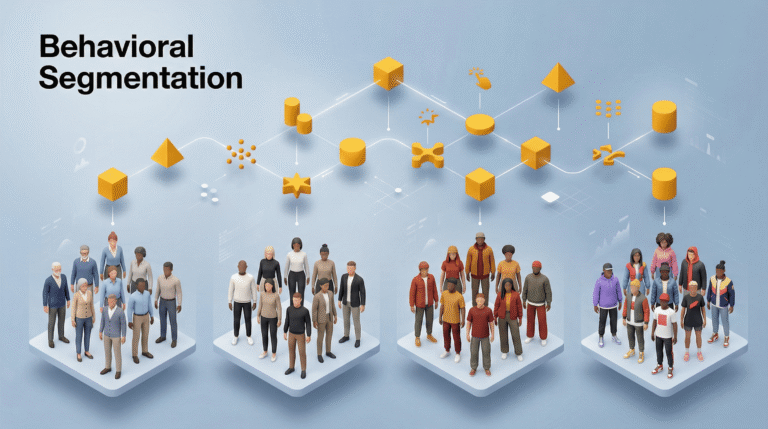
Behavioral segmentation groups customers based on actions such as purchase behavior, usage frequency, engagement patterns, responsiveness to marketing, or lifecycle stage.
This is the most directly actionable segmentation type for growth teams. For performance marketing, behavioral segmentation is often the primary driver of decision-making. It reveals where spending accelerates outcomes and where it simply follows existing demand.
How to do market segmentation analysis, step by step
Effective segmentation analysis can be broken down into steps, each structured around different decisions.
Step 1: Define the business question
Start with the decision that the segmentation must inform. Ask yourself:
-
Where should the media planning budget go?
-
Which customers are worth retaining at a higher cost?
-
Which segments justify differentiated pricing or service levels?
Make the question as specific as you can.
Step 2: Choose segmentation dimensions intentionally
Select segmentation types based on the question:
-
Budget allocation – Behavioral and geographic
-
Brand positioning – Psychographic and demographic
-
Measurement accuracy – Geographic and behavioral
Avoid layering dimensions without purpose.
Step 3: Validate segments with real data
Segments must be grounded in observable differences. Test whether segments:
-
Respond differently to marketing
-
Retain at different rates
-
Generate different margins or payback periods
If outcomes don’t differ meaningfully, the segmentation is cosmetic.
Step 4: Evaluate segments economically
Pressure-test each segment on:
-
Size and growth potential
-
Cost to acquire and serve
-
Contribution margin and lifetime value
This is where market segmentation analysis earns its keep. Attractive segments that destroy margin should not be prioritized.
Step 5: Translate insights into action
Analysis only matters if it changes behavior. To that end, outputs should clearly inform:
-
Targeting and suppression logic
-
Messaging and creative strategy
-
Media mix and budget allocation
If teams cannot articulate what they would do differently as a result, the segmentation has failed.
Common market segmentation mistakes that limit impact
Ultimately, market segmentation analysis is about making fewer, better decisions with confidence. However, teams can go off track and limit the impact of their segmentation if they fall into the trap of these common mistakes.
Over-segmenting without a decision in mind
When teams slice audiences thinner and thinner, chasing nuance, they’re left with dozens of segments with no clear priority. As a result, resources get spread thin, and high-value segments are treated the same as low-value ones.
Treating personas as static profiles
Personas are built once, socialized widely, and rarely revisited. What worked last year continues to be funded even as the economics have changed.
Ignoring economics and profitability
Segments are often ranked by size, engagement, or brand affinity. Here, high-volume, low-value customers crowd out segments that compound, which may be hidden in customer profitability analysis.
Running segmentation as a one-time research project
When segmentation is disconnected from measurement, experimentation, and forecasting, it can’t explain why or what to change.
Each of these mistakes has the same root cause: treating segmentation as an output instead of an operating input.
Turn segmentation analysis into strategy and action with fusepoint
Segmentation earns its keep only when it reshapes how the business allocates attention, money, and risk.
When done right, segmentation analysis informs brand and product messaging by clarifying which motivations and value propositions actually drive conversion, retention, and long-term value. It reveals where demand is elastic, where it’s fragile, and where incremental spend actually produces lift. Just as importantly, it shows which segments don’t deserve equal investment—an insight most teams avoid but high-performing ones act on.
At fusepoint, segmentation insights are never isolated from reality. Instead, they’re:
-
Pressure-tested against profitability
-
Validated through measurement
-
Embedded directly into planning, budgeting, and forecasting workflows
If your segmentation work hasn’t changed which customers you prioritize, it’s time to rethink your approach. fusepoint’s customer research services are designed for teams ready to turn audience understanding into a durable strategy and compounding action. Reach out today to get started.
Sources:
Harvard Business Review. Rediscovering Market Segmentation. https://hbr.org/2006/02/rediscovering-market-segmentation
ResearchGate. Market Segmentation Analysis: Understanding It, Doing It, and Making It Useful. https://www.researchgate.net/publication/326524789_Market_Segmentation_Analysis_Understanding_It_Doing_It_and_Making_It_Useful
ScienceDirect. Revisiting the strategic role of market segmentation: Five themes for future research. https://www.sciencedirect.com/science/article/abs/pii/S0019850124001202
Springer Nature Link. Intelligent customer segmentation: unveiling consumer patterns with machine learning. https://link.springer.com/article/10.1007/s43995-025-00180-7
Our Editorial Standards
Reviewed for Accuracy
Every piece is fact-checked for precision.
Up-to-Date Research
We reflect the latest trends and insights.
Credible References
Backed by trusted industry sources.
Actionable & Insight-Driven
Strategic takeaways for real results.
Emily Sullivan is an experienced marketing professional with over a decade of expertise in content creation, communications, and digital strategy. She thrives on translating complex, technical subject matter into content that is approachable, insightful, and genuinely useful to marketing professionals navigating a fast-evolving landscape.