



Behavioral segmentation explained: Definition, examples, and types

Emily Sullivan is an experienced marketing professional with over a decade of expertise in content creation, communications, and digital strategy. She thrives on translating complex, technical subject matter into content that is approachable, insightful, and genuinely useful to marketing professionals navigating a fast-evolving landscape.

Ola Wolski is a marketing research professional with nearly seven years of experience in social media strategy, innovative research, and data-driven marketing measurement. She thrives on digging into complex data to surface the clear, actionable insights that help brands measure what matters and invest with confidence in a rapidly evolving digital landscape.
- 1. What is behavioral segmentation in marketing?
- 2. Behavioral segmentation definition and meaning
- 3. How does behavioral segmentation identify target markets?
- 4. What are the four types of behavioral segmentation?
- 5. Behavioral segmentation examples
- 6. Behavioral market segmentation vs other segmentation models
- 7. Common mistakes in behavioral marketing segmentation
- 8. Turning behavioral segmentation into actionable growth with fusepoint

At the start of the week, traffic is up. But by Friday, the same customers who bought last week are already gone, with no repeat visits and no email responses. The team did everything “right” by demographic standards, yet behavior told a different story.
The reason is simple: What customers do (such as how often they buy, how they engage, when they drop off) predicts value far better than who they are on paper.
Put another way, two customers may look identical demographically, but one browses weekly, responds to email, and repurchases without discounts, while the other buys once during a sale and never returns. Treating them as the same customer leads to wasted spend and a diluted strategy.
Discover how to use behavioral segmentation to turn activity into a signal, below.
What is behavioral segmentation in marketing?
Behavioral segmentation in marketing groups customers based on what they do rather than who they are. Instead of relying on static attributes such as age or income, it segments audiences based on observed actions:
-
How often do they purchase
-
How they use a product
-
How they engage with marketing, and how their behavior changes over time.
Behavior is the closest proxy marketers have to intent, and to a large extent, it can reveal readiness.
In practice, behavioral segmentation is not just a personalization tactic. It supports targeting, measurement, and business decisions by showing which customers respond to marketing, which ones create value over time, and which behaviors signal growth or risk.
When done well, it becomes a foundation for how budgets are allocated and how marketing performance measurement is conducted.
Behavioral segmentation definition and meaning
What is behavioral segmentation? It’s the process of segmenting customers based on their actions, usage patterns, and decision-making behavior, then using those segments to inform marketing strategy and investment.
Common types of behavioral data include:
-
Purchase behavior – Frequency, recency, basket size, product mix
-
Usage behavior – Feature adoption, session depth, repeat usage
-
Engagement patterns – Email interaction, content consumption, channel preference
-
Loyalty signals – Renewals, referrals, repeat purchases
-
Risk indicators – Inactivity, declining usage, delayed purchases
For example, two customers may generate the same revenue in a quarter. However, one does so through frequent small purchases, while the other conducts a single large transaction followed by inactivity. Behavioral segmentation distinguishes among these patterns and treats them differently because their future value differs.
Put simply, behavioral segmentation is part of predictive customer analytics. It organizes customers in ways that explain what is likely to happen next.
Why behavioral segmentation matters in modern marketing
Modern marketing operates under constraints. From an efficiency standpoint, behavioral segmentation reduces waste. Instead of targeting broad audiences that include low-intent users, marketers can prioritize segments that show readiness to convert, renew, or expand.
This also improves measurement. When segments are defined by behavior, performance differences are easier to interpret. Lift, ROI, and payback become clearer because cohorts are more internally consistent. In fact, research from McKinsey & Company shows that banks that increase behavioral segmentation may collect 20-30% more in revenue.
How does behavioral segmentation identify target markets?
Behavioral segmentation identifies target markets by observing what customers signal through their actions rather than what they report in surveys or profiles.
Intent and readiness signals
Behavior often indicates where a customer is in their decision journey.
-
A repeat purchaser signals trust and familiarity.
-
A high-engagement user signals interest and exploration.
-
A dormant customer signals risk.
These signals help marketers distinguish between awareness audiences and conversion-ready segments without guessing.
Value and lifetime potential
Certain behaviors correlate strongly with long-term value.
For example:
-
Customers who purchase twice within a short window often have significantly higher lifetime value than one-time buyers.
-
Users who adopt key product features early tend to retain longer in SaaS.
-
Customers who engage across multiple channels are often more resilient to churn.
Behavioral segmentation surfaces these patterns and allows teams to prioritize segments that compound value rather than inflate volume.
Risk identification and intervention
Behavior also reveals where value is at risk.
Declining engagement, reduced usage frequency, or delayed repurchase are early signs of churn. Segmenting customers by these behaviors allows proactive intervention before revenue is lost.
Behavioral segmentation works because it’s grounded in reality. It reflects how customers actually behave, not how marketers hope they will. When tied to targeting, measurement, and growth decisions, it becomes one of the most reliable inputs for modern marketing strategy.
What are the four types of behavioral segmentation?
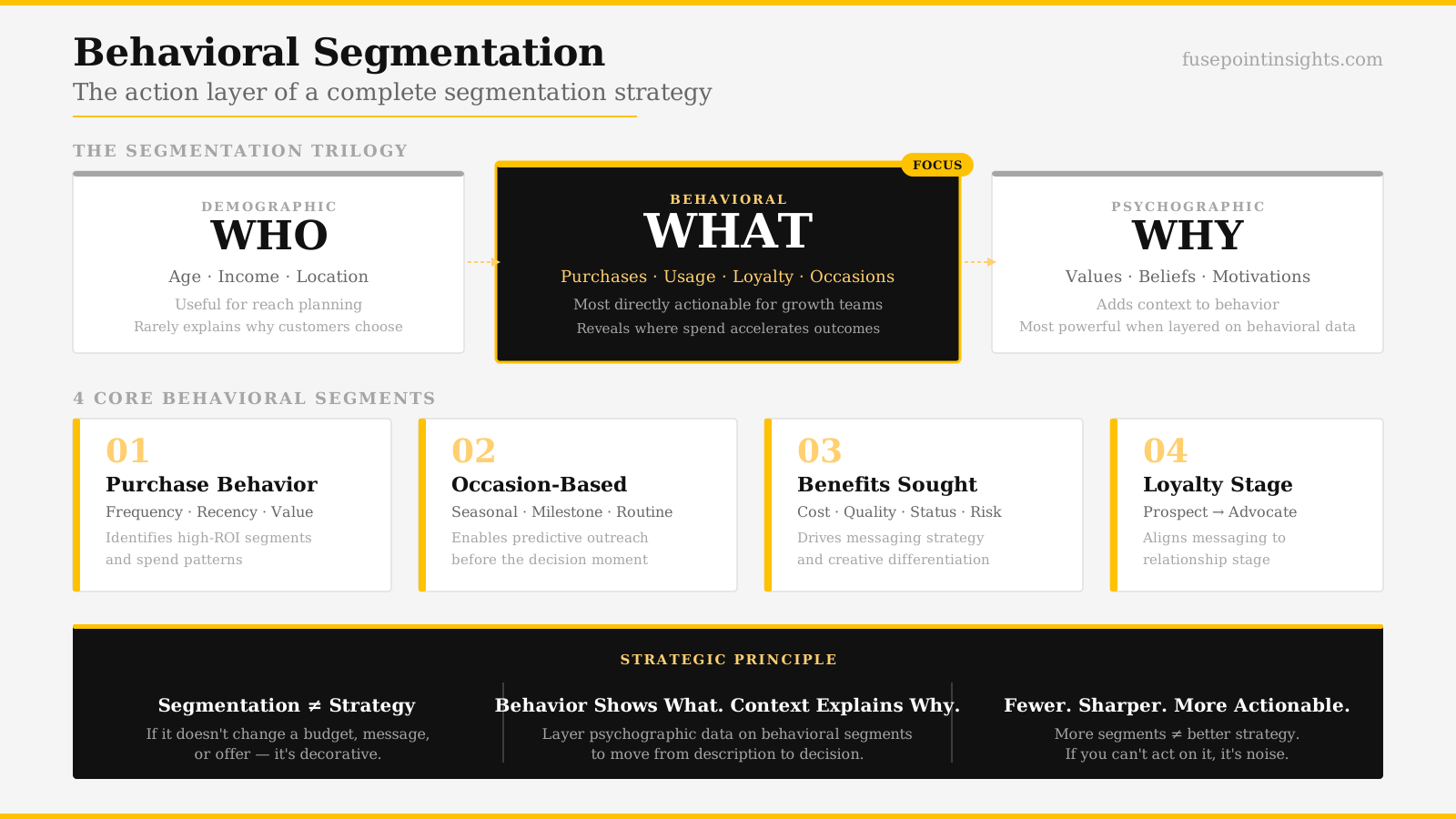
Broken down into four different perspectives, behavioral segmentation explains how customers interact with a product, brand, or category and what those interactions signal about future value.
Purchase behavior
This looks at how and when customers buy.
It includes patterns such as:
-
One-time purchaser vs. repeat purchaser
-
Buying on promotion vs. full price
-
Contract size
-
Renewal cadence
-
Upsell timing
These behaviors often reveal sensitivity to price, urgency, and trust. For instance, an eCommerce brand may find that customers who place a second order within 30 days are far more likely to become high-LTV customers. That insight changes onboarding flows, post-purchase messaging, and retargeting priorities.
Usage behavior
Usage behavior focuses on how customers interact after conversion.
This is critical in SaaS, subscriptions, and any product with ongoing engagement. Feature adoption, session frequency, depth of use, and time-to-value all signal retention risk or expansion potential.
For example, a SaaS company sees that users who activate two core features in their first week retain at double the rate of those who don’t. Marketing, product, and lifecycle teams then align around driving early activation rather than just trial signups.
Loyalty behavior
Loyalty behavior captures how committed customers are over time.
Renewals, repeat purchases, referrals, advocacy, and churn resistance all fall under this category. Loyalty is less about emotion and more about consistency of behavior.
Consider a DTC brand that observes that customers who subscribe after their third purchase churn at a much lower rate than those who subscribe immediately. That insight reshapes how subscriptions are positioned and when they’re introduced.
Benefit seeking
Benefit-seeking segmentation groups customers by the outcomes they seek.
Two customers may buy the same product for very different reasons: convenience, performance, status, cost savings, or risk reduction. Those motivations show up in behavior: the content they engage with, the features they use, and the offers they respond to.
An easy example comes from B2B software, where some buyers consistently explore automation features, while others focus on reporting and compliance tools. Both pay the same price, but their value drivers (and churn risks) are different.
Behavioral segmentation examples
Behavioral segmentation becomes powerful when it drives real decisions, not just targeting rules.
SaaS
A SaaS platform segments users by feature adoption velocity:
-
High-velocity adopters receive expansion messaging and sales outreach earlier.
-
Low-velocity users are routed into education and onboarding programs.
Media spend is shifting toward acquisition sources that historically deliver high-velocity cohorts.
B2B services
B2B offers one of the most common behavioral segmentation examples. A B2B firm segments accounts based on engagement behavior: content downloads, webinar attendance, and sales interaction frequency.
Accounts showing sustained engagement move into higher-touch ABM programs. Low-engagement accounts are deprioritized, reducing wasted sales effort.
Retail and eCommerce
Retailers often segment by purchase cadence and promotion sensitivity.
Customers who only buy during heavy discounts are treated differently from those who purchase consistently at full margin. Budget allocation changes accordingly: Promotional spend is constrained, while retention and loyalty investment increase for higher-margin cohorts.
Insurance and financial services
Insurers segment customers by renewal behavior and claim activity. Customers who renew early and rarely file claims receive proactive cross-sell offers, while high-risk segments trigger different pricing and communication strategies.
In each case, behavior informs where money goes, not just what message runs.
Behavioral market segmentation vs other segmentation models
Behavioral marketing segmentation answers a different question than other models. Here’s how demographics vs psychographics compare with behavioral segmentation:
-
Demographic segmentation tells you who your customers are.
-
Psychographic segmentation explains why they think and feel the way they do.
-
Behavioral segmentation shows what they actually do.
Psychographic vs behavioral segmentation
While psychographics uncover motivation, behavior confirms reality.
A customer may say they value sustainability, but behavioral data shows whether they pay a premium for eco-friendly options, switch brands, or churn when prices rise.
Thus, psychographics help shape messaging, but behavior determines investment.
Consequently, the strongest strategies layer these models:
-
Psychographics guide how you speak.
-
Behavior determines where and how much you spend.
Pro tip: When there’s conflict, behavior should lead strategy.
Common mistakes in behavioral marketing segmentation
Behavioral data is powerful, but it’s also easy to misuse if you’re unaware of common mistakes to watch out for.
Treating behavior as static
Behavior changes with context, such as pricing, competition, life stage, and product evolution. As such, segments need to be refreshed and revalidated, not hard-coded.
Over-segmenting without action
Creating dozens of micro-segments that don’t change decisions adds complexity without value. If a segment doesn’t affect budget, messaging, or prioritization, it’s noise.
Ignoring causality
Correlation is not intent. Put another way, high engagement doesn’t always cause high value. Without testing or incrementality analysis, teams risk optimizing for signals that don’t drive outcomes.
Separating segmentation from measurement
Behavioral segmentation should feed directly into media mix modeling (MMM), CLV modeling, and experimentation. When it lives only in CRM or campaign logic, its strategic value is capped.
At fusepoint, behavioral segmentation is treated as an economic tool. It exists to clarify value creation, reduce waste, and support decisions that withstand financial scrutiny.
Choosing the Right Metrics, Tools, and Tests to Drive Real Business Growth

 PDF
PDF
Turning behavioral segmentation into actionable growth with fusepoint
Behavioral segmentation closes the loop between what customers do and what businesses decide. When segments are built on actions rather than attributes, they become usable inside real measurement systems.
-
In attribution, behavioral segments clarify intent. A conversion from a first-time visitor behaves very differently from one driven by a repeat buyer or a highly engaged user. Treating those paths as equivalent distorts channel credit, but behavioral segmentation restores context.
-
In incrementality testing, behavior determines where tests should run and how results should be interpreted. A lift measured among high-frequency users means something very different from a lift among low-engagement cohorts. Without behavioral segmentation, experiments may answer the wrong question entirely.
-
In funnel measurement and media optimization, behavioral signals identify leverage points. They show where spending accelerates momentum and where it merely chases outcomes that would have happened anyway.
This is why behavioral segmentation is a strategic input that strengthens every layer of measurement when it’s properly built, tested, and refined.
At fusepoint, behavioral segmentation is integrated into our customer insight services. The fusepoint team connects observed behavior to causal impact, validates it through testing, and ties it back to financial outcomes like CLV, CAC, and margin. Beyond better targeting, this results in decisions and growth that can be defended.
When behavior informs measurement, and measurement informs action, marketing stops reacting and starts compounding. Contact fusepoint today to start compounding for your brand.
Sources:
McKinsey & Company. Behavioral insights and innovative treatments in collections. https://www.mckinsey.com.br/capabilities/risk-and-resilience/our-insights/behavioral-insights-and-innovative-treatments-in-collections
Taylor & Francis Online. A two-stage business analytics approach to perform behavioural and geographic customer segmentation using e-commerce delivery data. https://www.tandfonline.com/doi/full/10.1080/12460125.2022.2151071
Our Editorial Standards
Reviewed for Accuracy
Every piece is fact-checked for precision.
Up-to-Date Research
We reflect the latest trends and insights.
Credible References
Backed by trusted industry sources.
Actionable & Insight-Driven
Strategic takeaways for real results.
Emily Sullivan is an experienced marketing professional with over a decade of expertise in content creation, communications, and digital strategy. She thrives on translating complex, technical subject matter into content that is approachable, insightful, and genuinely useful to marketing professionals navigating a fast-evolving landscape.