




Geographic Segmentation Explained: Definition, Examples, and How Marketers Use Location Data

Emily Sullivan is an experienced marketing professional with over a decade of expertise in content creation, communications, and digital strategy. She thrives on translating complex, technical subject matter into content that is approachable, insightful, and genuinely useful to marketing professionals navigating a fast-evolving landscape.

Ola Wolski is a marketing research professional with nearly seven years of experience in social media strategy, innovative research, and data-driven marketing measurement. She thrives on digging into complex data to surface the clear, actionable insights that help brands measure what matters and invest with confidence in a rapidly evolving digital landscape.

- 1. Geographic segmentation definition and meaning
- 2. How do marketers use geographic segmentation?
- 3. Geographic segmentation examples in practice
- 4. How geographic segmentation improves Media Mix Modeling (MMM)
- 5. Using geographic segmentation to design better incrementality tests
- 6. Connecting geographic insights across MMM and incrementality frameworks
- 7. Using geographic segmentation to make better marketing decisions with fusepoint

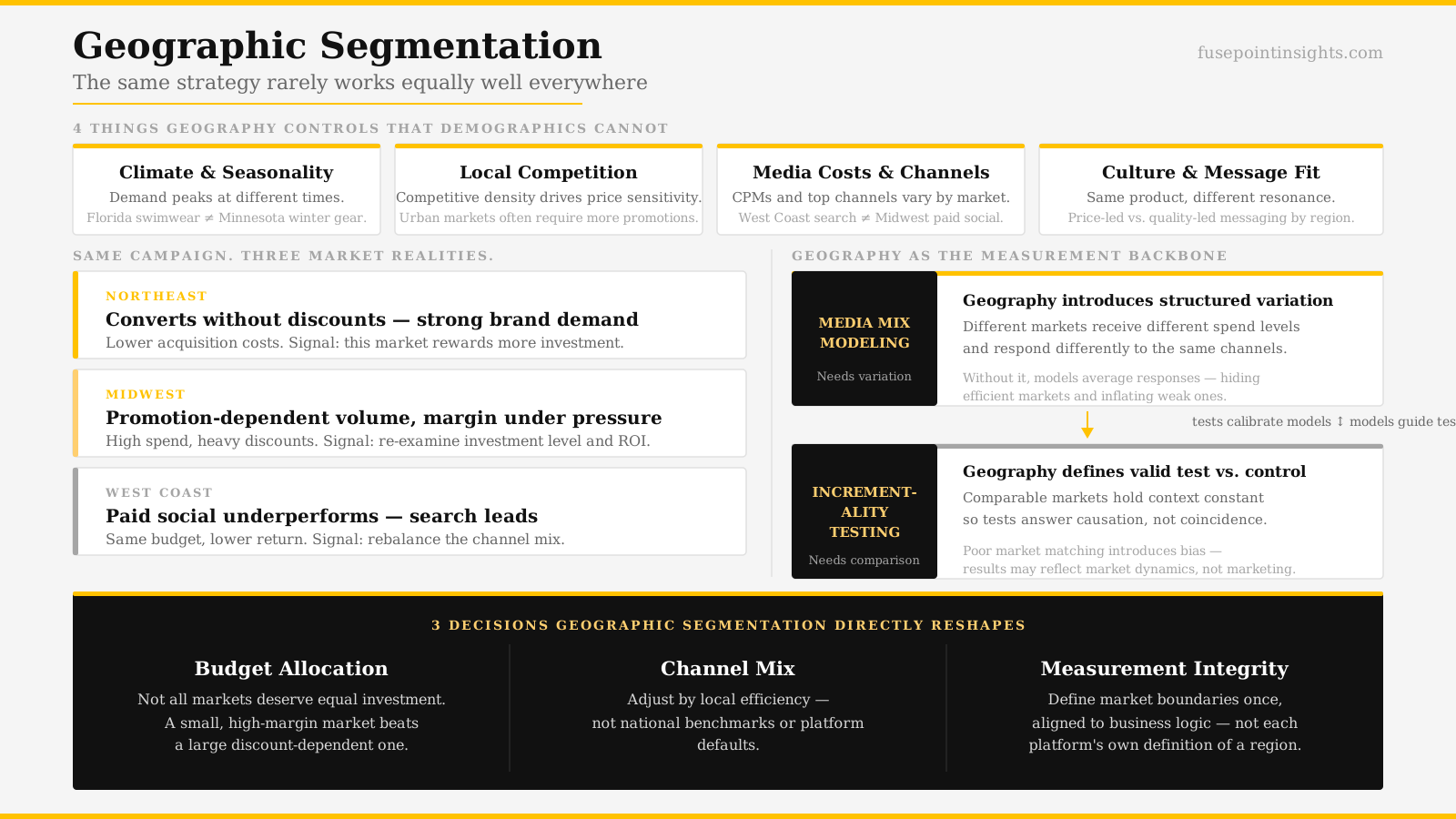
Your brand runs the same campaign across the U.S. However, in the Northeast, conversion rates are strong even without discounts, while the Midwest shows spikes in price sensitivity and promotions-driven volume. On the West Coast, paid social underperforms while search and retail media do the heavy lifting.
Nothing about the product changed. The difference was the customer’s location.
Geographic segmentation exists to explain these gaps. Consider: In Florida, swimwear and cold-drink messaging may perform all year, while in Minnesota, winter gear dominates seasonal demand. Markets like New York City and rural Texas may have similar population sizes, but the media mix, competitive landscape, and customer expectations vary dramatically.
For marketers, geographic segmentation goes beyond labeling customers by zip code. Instead, it recognizes that growth behaves differently by market, and uses location data to decide where to invest, where to localize, and where scale doesn’t make sense.
Geographic segmentation definition and meaning
Geographic segmentation definition is the practice of organizing customer, demand, and performance data by location to inform better marketing and investment decisions.
In practical terms, geographic segmentation in marketing answers a simple question: Does the same strategy work equally well everywhere? In most cases, the answer is no.
Geography shapes demand in ways that demographics alone cannot.
-
Climate affects purchasing cycles.
-
Local competition changes price sensitivity.
-
Media costs vary widely by market.
Even when products are identical, customer response rarely is. Geographic segmentation surfaces those differences so teams can stop managing to a national average that fits no market particularly well.
It’s also important to be clear about what geographic segmentation is not: It’s not just about geo-targeting ads or swapping city names in creative.
Used properly, geographic segmentation is an analytical lens. For example, a brand may see similar revenue across regions but very different unit economics. One market may deliver high volume but require heavy discounts and expensive media. Another may be smaller but far more profitable, driven by stronger brand demand and lower acquisition costs.
Geographic segmentation makes these tradeoffs visible.
How do marketers use geographic segmentation?
Marketers use geographic segmentation to move away from one-size-fits-all strategies and toward decisions grounded in how markets actually behave.
Tailoring messaging and offers by region
Customer needs and motivations differ by location. What resonates in one market can fall flat in another.
A retailer may find that price-led messaging performs best in highly competitive urban markets, while product quality or durability drives response in suburban or rural areas. Geographic segmentation allows messaging and offers to reflect those realities instead of forcing uniform creative everywhere.
Allocating budget across uneven markets
Not all markets deserve the same level of investment. Geographic segmentation helps identify where spend compounds and where it struggles to pay back.
Adjusting channel mix based on local efficiency
Channel performance is rarely consistent across regions. While search may dominate in some markets, paid social or offline media may play a larger role in others.
Geographic segmentation reveals these patterns. Over time, this reduces wasted media spend and improves overall efficiency without increasing total budget.
Accounting for seasonality, regulation, and culture
Consider a national retail brand running a single promotional calendar across all markets. In the Northeast, winter weather delays store traffic and pushes purchases later in the season. In the Southwest, demand peaks earlier as temperatures rise sooner.
When these markets are modeled together, performance looks inconsistent because the calendar is misaligned with local reality. However, geographic segmentation corrects this by anchoring planning to actual demand.
Geographic segmentation examples in practice
Having answered “How do marketers use geographic segmentation?”, let’s see how it impacts decision-making.
Retailers optimizing store-level promotions
Retail chains often see strong national performance from promotions, yet store-level margins tell a different story. Geographic segmentation exposes which locations respond to discounts and which erode profit through over-promotion.
Consider this geographic segmentation example: Stores in dense urban markets may require frequent promotions due to competitive pressure, while suburban locations may convert just as well with lighter incentives. Segmenting performance by store trade area allows retailers to protect margin where price sensitivity is lower.
DTC companies segmenting by region
A DTC apparel brand may see cold-weather regions convert strongly on outerwear at full price, while warmer regions require discounts or alternative product emphasis to drive volume. Running national promotions in this scenario unnecessarily compresses margin in high-intent markets.
By segmenting performance by region, ecommerce teams can tailor promotional intensity, featured products, and media spend—maximizing revenue where demand is strong and protecting margin where incentives are not required.
B2B companies targeting by territory or region
In B2B, geographic segmentation often maps to sales territories. Demand cycles, deal size, and close rates can vary significantly by region.
A SaaS company may find that West Coast accounts close faster but churn sooner, while Midwest accounts close slower but renew more reliably. Geographic segmentation informs investment decisions between demand generation and account expansion, improving efficiency and predictability.
How geographic segmentation improves Media Mix Modeling (MMM)
Media mix modeling (MMM) relies on variation, without which models struggle to distinguish signal from noise. Geography is one of the most powerful sources of that variation.
Capturing differences in channel efficiency
Markets don’t respond uniformly to media. A dollar of paid search in one region may deliver a strong incremental lift, while the same dollar in another merely captures existing demand.
Segmenting MMM inputs by geography allows the model to learn these differences. It captures where channels saturate faster, where returns diminish sooner, and where incremental lift persists at higher spend levels.
Without geographic segmentation, MMM averages the responses. That smoothing effect can make inefficient markets look better than they are, and efficient markets look less attractive than they deserve.
Improving elasticity and saturation estimates
Elasticity estimates depend on how performance changes alongside spending. Geographic segmentation provides natural experimentation: Different regions often receive different spend levels at different times.
That variation helps MMM isolate true response curves. It improves estimates of diminishing returns and reduces the risk of over-investing in saturated markets.
When geography is treated only as a reporting dimension, the model loses this learning opportunity.
Avoiding distorted ROI conclusions
Blended national models can hide structural differences. Geographic segmentation helps MMM separate baseline demand from media-driven impact, which is critical to budget allocation decisions aimed at increasing total business value.
At fusepoint, geography is built directly into MMM logic as a core dimension that improves model accuracy and decision relevance.
Using geographic segmentation to design better incrementality tests
Incrementality testing depends on comparison. Geography determines whether those comparisons are valid.
Selecting comparable test and control markets
Geo experiments and matched-market tests require regions that behave similarly in the absence of marketing intervention. Poor geographic segmentation undermines this requirement.
For example, testing spend changes in a fast-growing metro against a mature rural market introduces bias. Performance differences may reflect market dynamics rather than marketing impact. Proper geographic segmentation helps identify regions with comparable size, seasonality, and demand patterns.
Reducing noise and confounding factors
Geography shapes:
-
Competitive intensity
-
Pricing
-
External demand shocks
Ignoring these differences increases noise and weakens causal conclusions, especially while using media mix modeling.
Segmented geographies allow tests to control for these factors more effectively, improving confidence that the observed lift is driven by marketing, not by regional quirks.
Answering the right causal question
Incrementality tests should answer, “Did marketing cause this change?”, and not simply “Did performance change?”
Geographic segmentation ensures experiments isolate marketing’s role by holding market context constant. Without it, tests risk measuring coincidence rather than causality.
When segmentation is done correctly, incrementality testing becomes a powerful calibration tool. It validates MMM assumptions and grounds strategic decisions in real-world evidence.
Connecting geographic insights across MMM and incrementality frameworks
Geographic segmentation is the connective tissue between modeling and experimentation. It’s what enables MMM and incrementality testing to operate as a single system rather than parallel efforts that never quite reconcile.
In MMM, geography introduces structured variation.
-
Different markets receive different spend levels, face different competitive pressures, and respond differently to the same channels.
-
That variation is essential for isolating true channel impact. Without it, models rely too heavily on time-based changes alone, which limits their ability to distinguish causation from coincidence.
Incrementality testing benefits from the same structure. Geo experiments, matched-market tests, and holdout test designs all depend on clearly defined markets that behave similarly when marketing conditions remain unchanged. Geographic segmentation provides that baseline. It ensures test and control regions are comparable in size, demand patterns, and seasonality.
The relationship works in both directions.
-
Incrementality tests can calibrate geographically segmented MMMs. When a geo test shows that paid search delivers lower incremental lift in a region than the model predicted, it becomes a corrective signal. The MMM adjusts its elasticity assumptions for similar markets going forward, improving forecast accuracy.
-
MMM, in turn, helps prioritize where to test next. If the model shows high uncertainty or rapidly diminishing returns in a specific set of markets, those regions become candidates for experimentation. Testing effort is focused where learning has the greatest potential value, rather than being spread thin across the entire footprint.
Geography is what makes this loop possible. It’s the shared analytical layer both approaches can agree on.
Using geographic segmentation to make better marketing decisions with fusepoint
Most platforms offer geographic reporting, but very few provide geographic truth. That’s because each platform defines markets differently. None of these definitions is built to align with one another, and none are designed to support cross-channel measurement.
This creates two structural problems.
-
First, comparability breaks down. A “top-performing region” in one platform may not map cleanly to another. When teams try to reconcile performance across channels, they end up comparing different market definitions as if they were the same.
-
Second, optimization becomes siloed. Each platform pushes spend toward its own strongest geographies, regardless of whether those markets are already saturated or simply capturing demand driven elsewhere.
Effective geographic segmentation for MMM and incrementality requires something platforms can’t provide on their own:
-
Centralized data across channels
-
Consistent, business-defined market boundaries
-
Logic aligned to revenue, margin, and incremental lift
This is where durable marketing performance measurement systems diverge from surface-level reporting.
At fusepoint, geography is defined once, aligned to how the business actually operates, and applied consistently across MMM, attribution inputs, and experiments. Platform data is used, but it’s not allowed to define the analytical structure.
That distinction is critical. With it, geography becomes a decision layer that connects models, validates results, and grounds marketing investment in financial reality. And that’s exactly what fusepoint helps your brand achieve. Reach out today to learn how.
Sources:
International Journal of Services and Operations Management. Comparison of demographic, geographic, psychographic and behavioural approach to customer segmentation. https://www.inderscienceonline.com/doi/abs/10.1504/IJSOM.2021.119802
Emerald Insight. Marketing the downtown through geographically enhanced consumer segmentation. https://www.emerald.com/jpmd/article-abstract/2/2/125/231564/Marketing-the-downtown-through-geographically?redirectedFrom=fulltext
MDPI. Geo-Marketing Segmentation with Deep Learning. https://www.mdpi.com/2673-7116/1/1/5
Our Editorial Standards
Reviewed for Accuracy
Every piece is fact-checked for precision.
Up-to-Date Research
We reflect the latest trends and insights.
Credible References
Backed by trusted industry sources.
Actionable & Insight-Driven
Strategic takeaways for real results.
Emily Sullivan is an experienced marketing professional with over a decade of expertise in content creation, communications, and digital strategy. She thrives on translating complex, technical subject matter into content that is approachable, insightful, and genuinely useful to marketing professionals navigating a fast-evolving landscape.