




Unified marketing measurement: A practical guide to smarter marketing analytics

Emily Sullivan is an experienced marketing professional with over a decade of expertise in content creation, communications, and digital strategy. She thrives on translating complex, technical subject matter into content that is approachable, insightful, and genuinely useful to marketing professionals navigating a fast-evolving landscape.

Ben Dutter is Chief Strategy Officer at Power Digital and founder of fusepoint, a data and strategy consultancy powered by deep marketing intelligence. He’s spent nearly 20 years driving growth for brands like Amazon, Crocs, and Liquid Death, with a focus on ethical, effective, data-driven marketing.

- 1. What is unified marketing measurement (UMM)?
- 2. Why traditional measurement frameworks fall short
- 3. How unified marketing measurement works
- 4. The core components of a unified measurement system
- 5. Benefits of unified marketing measurement
- 6. Implementing unified marketing measurement
- 7. Building a single source of marketing truth with fusepoint

Marketing measurement has never been more sophisticated, or more fragmented.
Teams run attribution models to optimize campaigns, media mix models to guide budgets, and incrementality tests to prove lift. While each model answers a real question, they rarely agree.
As channels multiply and privacy constraints tighten, these systems begin to tell different stories about performance. Attribution favors what’s easy to track, and MMM looks at long-term impact but moves slowly. On the other hand, experiments deliver clarity, but only in narrow slices. When these signals conflict, marketers are left reconciling spreadsheets instead of making decisions.
What is unified marketing measurement (UMM)?
This begs the question: What is Unified Marketing Measurement (UMM)? Put simply, it brings together MMM, attribution, and incrementality under a single logic framework, connecting short-term optimization with long-term financial outcomes. Instead of choosing which metric to trust, UMM shows how each fits into the same decision system.
At its core, unified Marketing Measurement is a methodological approach that connects attribution, MMM, and incrementality testing into a single decision framework. Instead of forcing teams to choose which model to trust, UMM defines how each model contributes to the same understanding of impact.
-
Attribution informs short-term optimization and in-platform decisions.
-
Media mix modeling provides a macro view of long-term, cross-channel impact.
-
Incrementality testing validates causality and pressure-tests assumptions.
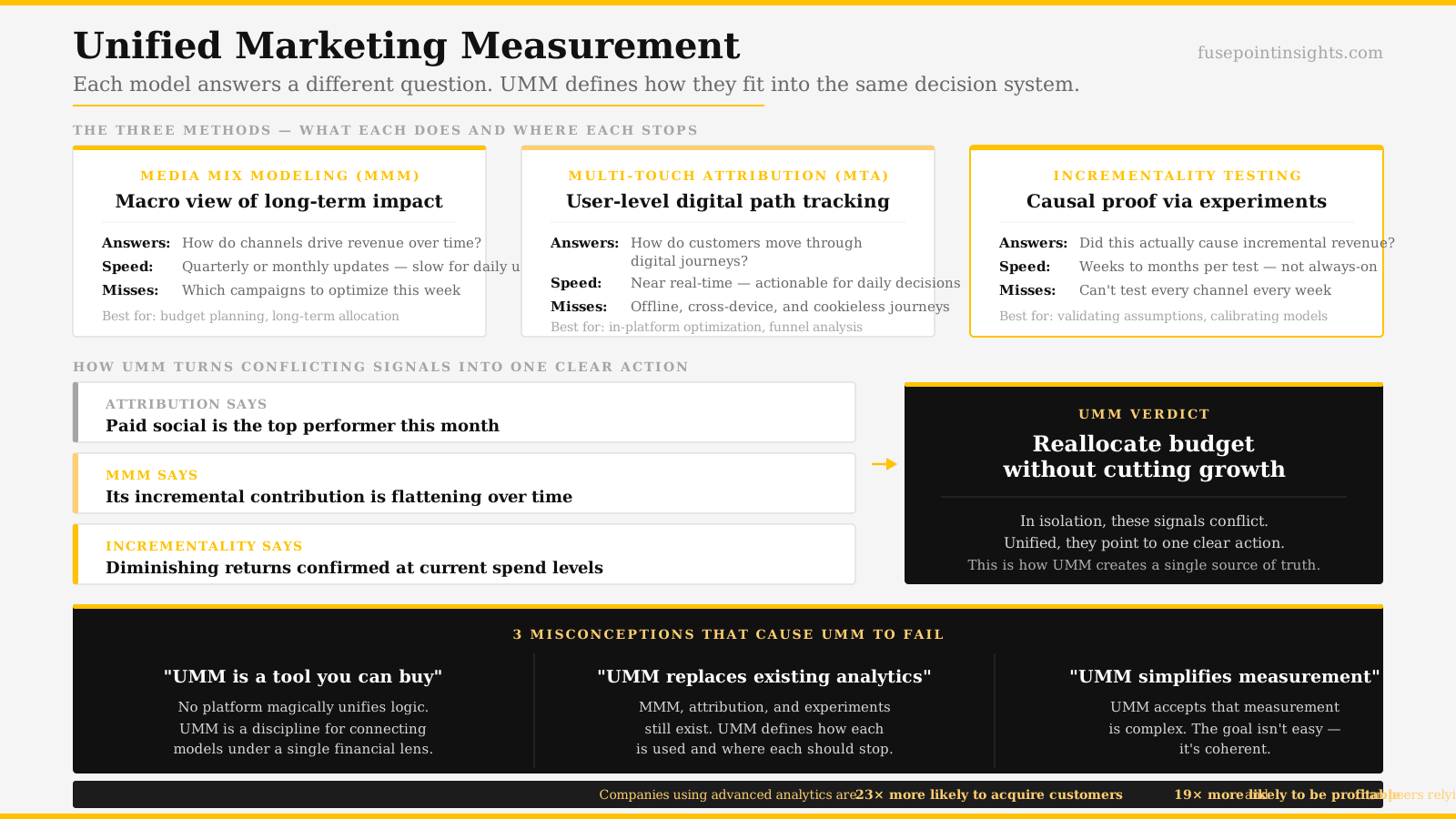
Relying on a single lens creates blind spots. Additionally, analytics show exactly which part of the system is broken: Companies using advanced analytics across decision-making processes are 23 times more likely to acquire customers and 19 times more likely to be profitable than peers relying on siloed analytics.
A single logic framework for impact
The defining feature of UMM is consistency. All models are anchored to the same business logic of revenue and ROI rather than competing definitions of success.
For example:
-
An attribution model may suggest paid social is the top performer this month.
-
MMM may show that its incremental contribution is flattening.
-
An incrementality test may confirm diminishing returns at current spend levels.
In isolation, these insights conflict. Unified, they point to a clear action: Reallocate the budget without cutting growth. This is how UMM creates a single source of truth.
Not a tool, but a discipline
Beyond being a dashboard or platform feature, UMM is a framework for structuring analysis so that every metric helps you determine whether a particular investment can deliver a profitable impact.
While tools can report numbers, a unified framework explains how those numbers relate and how confident you should be in acting on them.
For organizations operating across complex media mixes, UMM becomes the only way to connect short-term signals to long-term financial outcomes without flying blind.
Why traditional measurement frameworks fall short
Most measurement failures come from treating partial views as complete answers.
Marketing mix modeling (MMM)
MMM asks the right question about the factors actually driving incremental business results over time. By analyzing historical spend against revenue, it captures long-term, cross-channel impact, including offline effects.
However, the tradeoff is latency. MMM typically updates quarterly, sometimes monthly. That makes it useful for budget and media planning, but blunt for day-to-day decisions. A CMO might know that TV and paid social drive long-term lift, but still lacks clarity on which campaigns to optimize this week.
Multi-touch attribution (MTA)
MTA promises precision. It tracks user-level paths across digital touchpoints and assigns credit accordingly. For performance marketers, it’s appealing because it feels actionable and immediate.
But that precision depends on data that’s disappearing, due to:
-
Privacy changes
-
Cookie loss
-
Walled gardens
-
Incomplete cross-device tracking.
Google itself has acknowledged that attribution models are increasingly constrained by signal loss.
The result is a skewed view of performance. Channels that are easier to track (such as branded search and retargeting) often appear stronger than they are, while upper-funnel and offline drivers receive less credit.
Incrementality testing
Incrementality experiments (such as geo tests, holdouts, and conversion lift) are the gold standard for establishing causality.
However, the limitation is scale, since you can’t run controlled experiments on every channel, every week, without disrupting the business.
How unified marketing measurement works
Unified Marketing Measurement (UMM) treats measurement as an ecosystem. Each method plays a defined role, and each cross-checks the others.
-
Setting the foundation with MMM: UMM starts with MMM as the top-down anchor. It establishes how channels perform, in aggregate, over time, against real business outcomes such as revenue and margin.
-
MTA adds tactical resolution: Where user-level data is reliable, it adds bottom-up detail. It helps teams understand how customers move through digital journeys and where friction or opportunity exists.
-
Incrementality testing keeps the system rooted in reality: Experiments act as calibration points. Their results feed back into both MMM and attribution logic.
In a unified framework, discrepancies are investigated. If MMM vs MTA say two different things, you must ask yourself: “What is each tool telling us about time horizon, data gaps, or causality?”
The core components of a unified measurement system
Unified Marketing Measurement only works if the foundation is sound.
Centralized, clean data infrastructure
Every measurement framework depends on the same raw inputs:
-
Spend
-
Exposure
-
Conversions
-
Revenue
-
Pricing
-
External factors
When those inputs live in disconnected systems, every model inherits the inconsistency. What’s more, Gartner estimates that poor data quality costs organizations an average of $12.9 million per year, largely due to rework. In marketing, that cost often shows up as contradictory performance readouts across channels.
Standardized taxonomy across channels and KPIs
When one team defines a “conversion” differently from another, alignment breaks immediately.
Standardizing channel definitions, conversion events, and KPI hierarchies creates a shared language. It ensures that when MMM, MTA, and experiments speak, they are answering the same business question from different angles.
Continuous validation loop
The final component is feedback. A unified system must test itself.
-
Incrementality experiments validate MMM assumptions.
-
MMM highlights where experiments are most needed.
-
Attribution signals help detect short-term shifts that warrant deeper testing.
This loop keeps measurement honest. It ties every model back to observed business performance, rather than allowing estimates to drift unchecked.
Benefits of unified marketing measurement
When these components work together, the impact shows up in how decisions are made and defended.
One version of performance
A unified framework produces a single, consistent view of marketing impact. Channel teams may still own tactics, but they no longer operate with competing truths.
Fewer internal disputes, faster decisions
Without UMM, disagreements over performance become political. Each team points to the model that favors its channel, and time is spent reconciling numbers instead of reallocating spend.
Unified measurement shifts the conversation from “whose numbers are right” to “what do we do next,” because the logic is shared even if the inputs differ.
Better budget allocation and forecasting
When MMM, attribution, and experiments reinforce each other, forecasts become more stable. Leaders can see not just what performed last quarter, but which investments are likely to compound value over time.
Alignment with finance, not just marketing
Perhaps most importantly, UMM aligns marketing measurement with how the business is actually evaluated: revenue, margin, and return on invested capital.
Instead of defending channel performance in isolation, marketing can speak in the same terms that finance uses to assess any investment.
Implementing unified marketing measurement
Unified marketing is a system you assemble deliberately, starting with what already exists and tightening the logic over time.
Start with a readiness audit
Most organizations already run some combination of MMM, attribution, and experiments. The first step is to understand how mature each is. An audit typically asks:
-
Is your MMM refreshed quarterly, annually, or on an ad hoc basis?
-
Is attribution used for optimization or mistaken as a source of truth?
-
Are experiments isolated tests or part of a broader measurement plan?
This diagnostic step is important because UMM doesn’t work if one model is treated as “right” and the others as secondary.
Media Mix Modeling (MMM) can reveal what’s really driving your marketing performance, but only if your data is clean, complete, and well-structured. Too often, brands dive into modeling only to find critical data gaps and inconsistencies midstream.

 PDF
PDF
Identify overlaps and gaps
Next comes the unglamorous work: mapping where data overlaps and where it disappears.
A common example is that paid social conversions appear in attribution but differ in MMM, and are partially excluded from experiments due to targeting constraints.
If those differences aren’t reconciled, teams may argue over performance rather than improve it.
Standardize how the business defines performance
UMM fails quickly without a shared taxonomy.
That means aligning:
-
Channel definitions (what counts as “paid social” vs. “video”)
-
Conversion logic (lead vs. qualified lead vs. revenue)
-
Time windows and attribution assumptions
Without this, model outputs cannot be compared or synthesized.
Common misconceptions about unified measurement
Unified marketing measurement is often misunderstood, and that’s precisely what leads to failure.
Common misconceptions include:
-
“UMM is a tool” – It isn’t. There’s no platform you can buy that magically unifies logic. Instead, treat UMM as a discipline for connecting models, assumptions, and decisions under a single financial lens.
-
“UMM replaces existing analytics” – It doesn’t. MMM, attribution, and experiments still exist. UMM simply defines how each is used and where each should stop.
-
“UMM simplifies measurement” – In reality, it does the opposite. UMM accepts that marketing measurement is complex. Its goal is not to make it easy, but to make it coherent.
When done right, teams stop arguing about whose number is correct and start debating which decision makes sense given the evidence.
Building a single source of marketing truth with fusepoint
Fragmented measurement fails because each model answers a different question in isolation. Without a unifying structure, those answers compete for attention.
Unified marketing measurement bridges the gap. It brings models, data, and experimentation into a single logical system, enabling decisions that hold up when budgets tighten.
fusepoint makes it easy. Partner with fusepoint, and you’ll get measurement systems that are:
-
Testable, so that assumptions can be challenged.
-
Traceable, so every recommendation ties back to business outcomes.
-
Durable, so insights don’t collapse when channels shift.
If your current measurement stack feels fragmented or backward-looking, that’s a systems problem, and it’s one that fusepoint is uniquely equipped to solve through marketing performance measurement consulting. Reach out today to turn your marketing data into decision-grade truth.
Sources:
McKinsey & Company. Using customer analytics to boost corporate performance. https://www.mckinsey.com/
ScienceDirect. Intelligent attribution modeling for enhanced digital marketing performance. https://www.sciencedirect.com/science/article/pii/S2667305324000139
Gartner. Data Quality: Best Practices for Accurate Insights. https://www.gartner.com/en/data-analytics/topics/data-quality
Think With Google. Unified Marketing Measurement: The Power of Blending Methodologies. https://www.thinkwithgoogle.com/_qs/documents/13385/TwGxOP_Unified_Marketing_Measurement.pdf
Our Editorial Standards
Reviewed for Accuracy
Every piece is fact-checked for precision.
Up-to-Date Research
We reflect the latest trends and insights.
Credible References
Backed by trusted industry sources.
Actionable & Insight-Driven
Strategic takeaways for real results.
Emily Sullivan is an experienced marketing professional with over a decade of expertise in content creation, communications, and digital strategy. She thrives on translating complex, technical subject matter into content that is approachable, insightful, and genuinely useful to marketing professionals navigating a fast-evolving landscape.