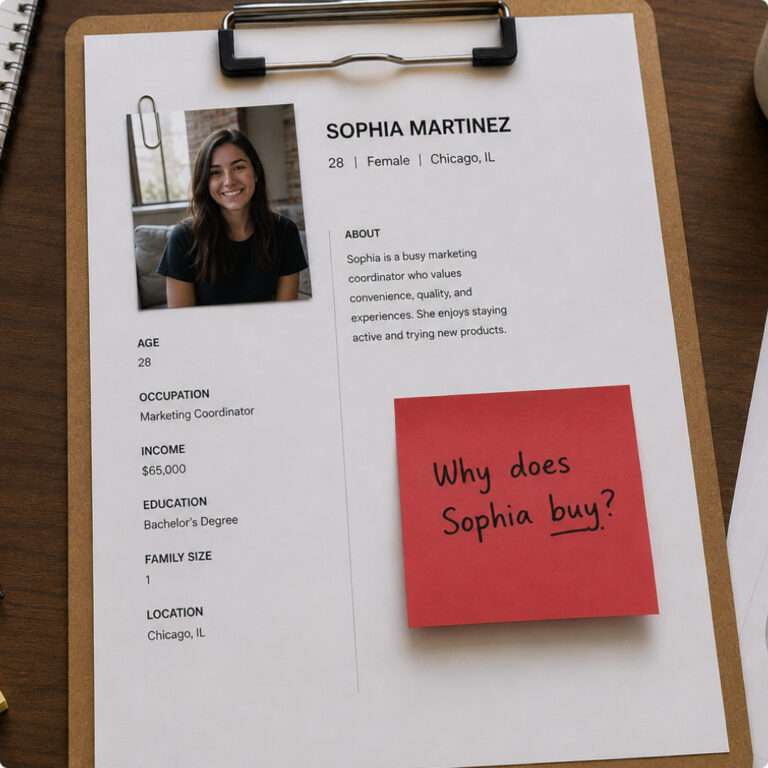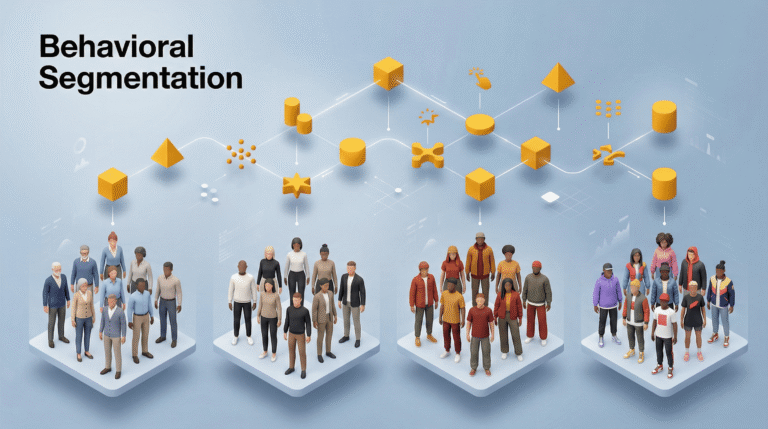




Psychographic segmentation explained: Definition, examples, and marketing use cases

Emily Sullivan is an experienced marketing professional with over a decade of expertise in content creation, communications, and digital strategy. She thrives on translating complex, technical subject matter into content that is approachable, insightful, and genuinely useful to marketing professionals navigating a fast-evolving landscape.

Ola Wolski is a marketing research professional with nearly seven years of experience in social media strategy, innovative research, and data-driven marketing measurement. She thrives on digging into complex data to surface the clear, actionable insights that help brands measure what matters and invest with confidence in a rapidly evolving digital landscape.

- 1. What is psychographic segmentation?
- 2. Psychographic segmentation vs demographic and behavioral segmentation
- 3. Common psychographic segmentation variables
- 4. How psychographic segmentation improves marketing performance
- 5. Common mistakes brands make with psychographic segmentation
- 6. Building a psychographics-enhanced strategy with fusepoint

As a buyer, you don’t make decisions purely rationally. You may weigh risk and favor familiarity or novelty depending on context. Most importantly, you likely do all of that before price or features ever enter the picture.
Psychology explains this through the Big Five personality model, which posits that traits such as openness, conscientiousness, and risk tolerance consistently shape how people make decisions. Two customers can see the same offer, at the same price, and react in completely different ways.
That’s the foundation of psychographic market segmentation.
Instead of grouping customers by age, income, or location, psychographic segmentation organizes them by attitudes, motivations, values, and decision styles. For marketers, understanding this mindset behind the purchase is key to sharpening strategy.
What is psychographic segmentation?
Psychographic segmentation definition marketing is the practice of grouping customers by the reasons behind their decisions.
Where demographic segmentation tells you who a customer is, psychographic segmentation explains what they care about and what drives their choices. That distinction matters because relevance rarely comes from identity alone.
Considering demographics vs psychographics, two similar-looking customers can behave very differently:
-
One may value convenience and speed.
-
Another may prioritize quality or sustainability, even at a higher price.
While demographics won’t surface that difference, psychographics will.
In marketing, psychographic segmentation helps teams understand why certain messages resonate, why some offers feel compelling, and why price sensitivity varies across customers who otherwise look identical. It’s the layer that turns messaging from generic to persuasive.
This is especially important as audiences grow more skeptical and more selective. According to McKinsey, 71% of consumers expect companies to deliver personalized interactions, and 76% get frustrated when this doesn’t happen. Here, psychographic segmentation is one of the few ways to move personalization beyond surface-level customization and toward meaningful relevance.
Benefits of psychographic segmentation
Psychographic data is rarely pulled from a single source. In practice, it’s assembled from multiple inputs:
-
Surveys and interviews that capture stated preferences, motivations, and attitudes
-
Qualitative research, such as focus groups or customer interviews
-
Behavioral signals that imply intent, such as content consumption, feature usage, or product mix
-
Customer insights analysis combining purchase history with engagement patterns
Importantly, psychographic segmentation does not replace demographic or behavioral models. It complements them. Used together, these layers allow marketers to:
-
Craft messages that align with customer values, not just product features
-
Avoid overusing discounts when motivation is emotional or belief-driven
-
Prioritize value propositions that match long-term loyalty drivers.
Psychographic segmentation vs demographic and behavioral segmentation
Now that “what is psychographic segmentation?” has been answered, it must be distinguished from other segmentation types.
Each segmentation type answers a different question. Problems arise when teams expect one to do the work of all three.
-
Demographic segmentation answers who customers are, as part of predictive customer analytics. It’s useful for reach planning and high-level targeting. However, its limitation is bluntness: Knowing a customer’s age or income rarely explains why they chose one brand over another.
-
Behavioral segmentation answers what customers do. It captures actions: purchases, clicks, usage patterns. This is powerful for optimization, but it’s descriptive. Behavior alone doesn’t explain motivation.
Psychographic segmentation answers why customers behave the way they do. It reveals intent, priorities, and tradeoffs.
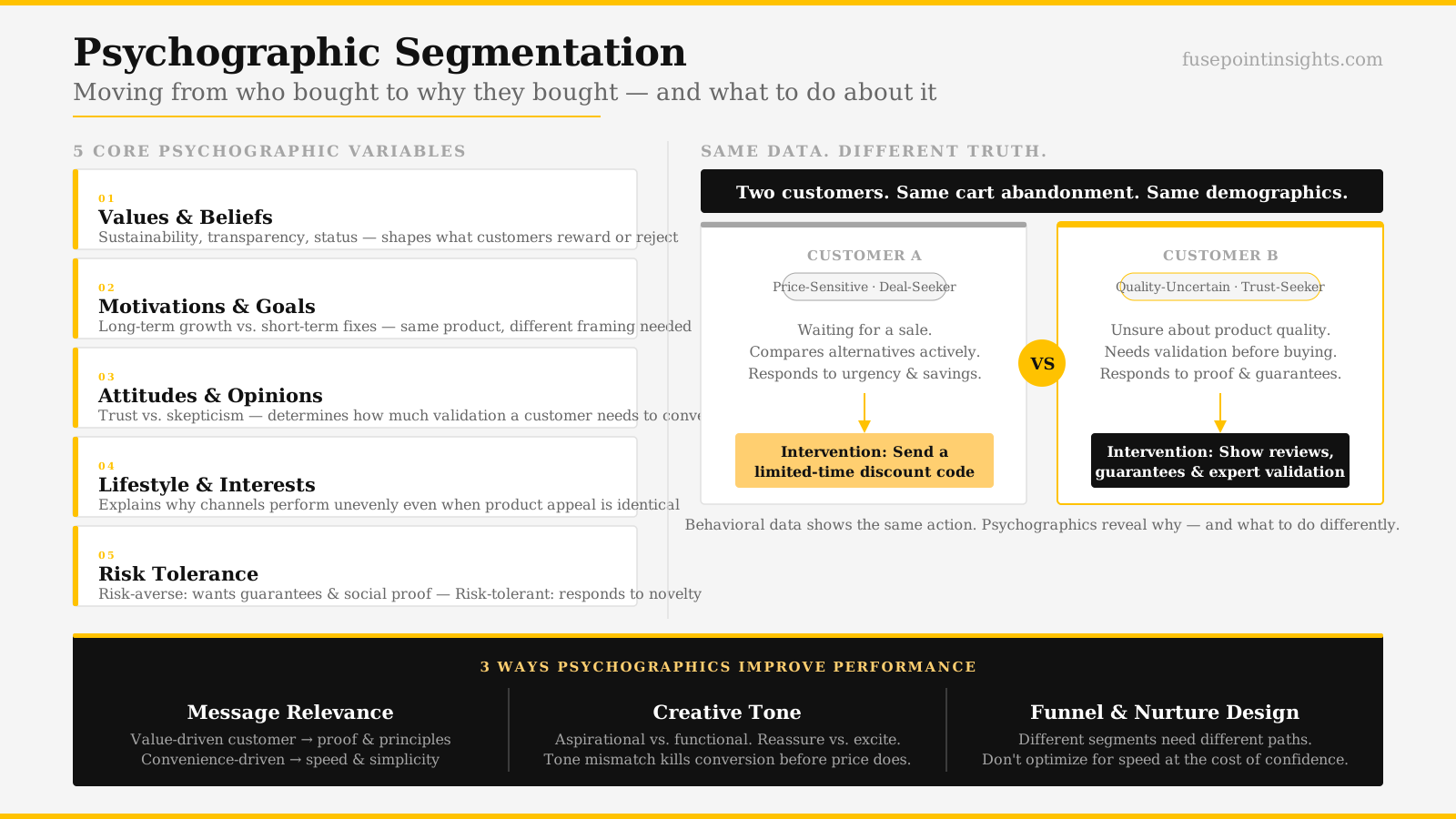
For example, consider two users abandoning a cart. Behavioral data indicate the same actions, and demographics show similar profiles. However, psychographics reveal one is price-sensitive and waiting for a sale, while the other is unsure about product quality.
Those insights lead to very different interventions. One calls for a promotion. The other calls for reassurance, reviews, or guarantees.
Thus, psychographics are most valuable when layered on top of behavioral and demographic data. They help marketers decide when to personalize messaging, how to frame value, and where to invest creative effort.
Common psychographic segmentation variables
To isolate decision drivers, you must account for the following psychographic segmentation variables.
Values and beliefs
Values shape what customers reward or reject, often independent of price.
For example, some customers prioritize sustainability, transparency, or ethical sourcing and may want to see proof points such as sourcing details.
Others value convenience, speed, or status and respond better to faster delivery, ease of use, or bundled offers.
The mistake teams make is assuming values are universal. When messaging ignores this split, brands either over-explain to customers who don’t care or under-signal to those who do.
Motivations and goals
Motivation explains why a customer is engaging at a given moment.
In subscription businesses, one segment may be motivated by long-term improvement (health, learning, skill-building), while another is motivated by short-term problem solving. The same product can satisfy both, but the framing must change.
Attitudes and opinions
Attitudes influence trust and skepticism.
Some customers want reassurance through reviews, comparisons, and expert validation, while others want autonomy. Heavy-handed messaging that works for one group can actively repel the other.
This variable is especially relevant in regulated or high-consideration categories such as finance, insurance, and healthcare, where trust signals materially affect conversion rates.
Lifestyle and interests
Lifestyle shapes where and when customers engage.
A time-constrained professional interacts with media differently from a hobbyist or enthusiast. These types of lifestyle differences often explain why channels perform unevenly across segments, even when the product appeal is the same.
Risk tolerance and decision-making style
Risk tolerance determines how much friction customers are willing to accept before buying.
-
Risk-averse segments want guarantees, trials, and social proof.
-
Risk-tolerant segments are more responsive to novelty and exclusivity.
This variable directly informs the design of offers and CTAs.
At fusepoint, psychographic variables are never analyzed in isolation. Instead, they’re tied back to performance metrics, so segmentation informs what to do differently, not just how to describe customers.
How psychographic segmentation improves marketing performance
Psychographic segmentation in marketing improves performance by aligning marketing with intent, not just exposure.
Message relevance and personalization
Psychographic segmentation allows marketers to speak to what matters most to different groups.
-
A value-driven customer responds to proof and principles.
-
A convenience-driven customer responds to speed and simplicity.
In such psychographic segmentation examples, the same product can be positioned differently without fragmenting the brand. This increases engagement because customers identify with the message.
Creative strategy and tone
Creative often underperforms not because it’s bad, but because it’s mismatched.
-
Some segments respond to aspirational storytelling.
-
Others prefer direct, functional language.
-
Some are persuaded by authority and expertise.
-
Others need social proof or peer validation.
Psychographic segmentation gives creative teams a framework for tone, not just visuals. It answers questions like:
-
Should this message reassure or excite?
-
Should it educate or simplify?
-
Should it emphasize control or convenience?
When tone aligns with decision style, creative stops feeling generic and starts converting more consistently.
Funnel design and nurture paths
Funnels break when they assume all customers progress the same way, but psychographic segmentation reveals where that assumption fails.
Designing different nurture paths by psychographic segment improves conversion and retention. It prevents teams from over-optimizing for speed at the expense of confidence, or vice versa, thereby improving customer profitability analysis.
Common mistakes brands make with psychographic segmentation
Psychographic segmentation fails most often not because the idea is flawed, but because execution is shallow.
Relying on stereotypes instead of evidence
Stereotypes flatten nuance. Labels like “eco-conscious,” “premium buyer,” or “value seeker” sound useful but quickly become assumptions if they aren’t grounded in research or behavior.
Creating segments that are too broad or too small
Overly broad segments don’t change decisions, and overly narrow ones can’t scale.
Effective psychographic segments are large enough to matter financially, but distinct enough to behave differently. If a segment doesn’t change how you allocate media budget, design creative, or build funnels, it’s not worth investing in.
Treating psychographics as static
Brands that treat psychographic segments as permanent truths end up optimizing for yesterday’s mindset. Segmentation needs to be revisited and pressure-tested as behavior evolves.
Ignoring behavioral data
Psychographics explain why, but behavior shows what actually happens.
When psychographic insights aren’t validated against real actions (such as conversion rates, churn, and upsell performance), they drift into storytelling. The strongest segmentation frameworks tie motivation directly to performance outcomes.
Failing to link segmentation to business goals
The most common failure is stopping at insight.
Psychographic data only creates value when it informs real decisions, such as:
-
Which messages to prioritize
-
Which offers to test
-
Which segments to invest in
As a marketing science company, fusepoint treats psychographic segmentation as a performance lever. It’s useful only to the extent that it improves relevance, efficiency, and long-term value.
Building a psychographics-enhanced strategy with fusepoint
Psychographic segmentation works best when it’s treated as infrastructure, not output. On its own, it adds color to your customer profile. Integrated into broader customer insights services, it explains why customers behave as they do and how marketing should respond.
That connection strengthens every downstream decision:
-
Persona development is grounded in real motivation
-
Testing is more targeted
-
Cross-channel strategies are easier to prioritize
Most importantly, psychographic segmentation shifts marketing from description to decision-making. When values and motivations are understood and tied to outcomes like conversion, retention, and lifetime value, marketing becomes more durable.
At fusepoint, psychographic segmentation is part of a larger measurement system, combining qualitative insight with behavioral and financial data to ensure segmentation leads to action.
If your brand needs strategies that reflect how customers actually decide, and to turn that understanding into lasting growth, contact fusepoint today.
Sources:
Sage Journals. Impact of Personality Traits and Demographic Factors on Risk Attitude. https://journals.sagepub.com/doi/10.1177/21582440211066917
McKinsey & Company. The value of getting personalization right—or wrong—is multiplying. https://www.mckinsey.com/capabilities/growth-marketing-and-sales/our-insights/the-value-of-getting-personalization-right-or-wrong-is-multiplying
ScienceDirect. Psychographic segmentation of multichannel customers: investigating the influence of individual differences on channel choice and switching behavior. https://www.sciencedirect.com/science/article/pii/S0969698924001024
MDPI. Influencing Green Purchase Intention through Eco Labels and User-Generated Content. https://www.mdpi.com/2071-1050/15/1/764
Our Editorial Standards
Reviewed for Accuracy
Every piece is fact-checked for precision.
Up-to-Date Research
We reflect the latest trends and insights.
Credible References
Backed by trusted industry sources.
Actionable & Insight-Driven
Strategic takeaways for real results.
Emily Sullivan is an experienced marketing professional with over a decade of expertise in content creation, communications, and digital strategy. She thrives on translating complex, technical subject matter into content that is approachable, insightful, and genuinely useful to marketing professionals navigating a fast-evolving landscape.