



Customer segmentation analysis: Turning data into decisions that drive profit

Emily Sullivan is an experienced marketing professional with over a decade of expertise in content creation, communications, and digital strategy. She thrives on translating complex, technical subject matter into content that is approachable, insightful, and genuinely useful to marketing professionals navigating a fast-evolving landscape.

Ola Wolski is a marketing research professional with nearly seven years of experience in social media strategy, innovative research, and data-driven marketing measurement. She thrives on digging into complex data to surface the clear, actionable insights that help brands measure what matters and invest with confidence in a rapidly evolving digital landscape.

- 1. What is customer segmentation analysis?
- 2. Why segmentation matters for strategy and profitability
- 3. Core segmentation frameworks and methods
- 4. Turning segmentation insights into action
- 5. Connecting customer segmentation to measurement and MMM
- 6. Common pitfalls in segmentation
- 7. Building a durable segmentation framework with fusepoint

Imagine running a store where every shopper looks busy, baskets are full, and revenue keeps ticking up, but profits stay flat. Some customers return repeatedly with minimal effort. Others require constant discounts and high-touch support. If you treat them all the same, your strategy optimizes for activity rather than value.
That’s the gap customer analysis segmentation is meant to close. Segmentation moves beyond labels like age, income, or geography and into something far more useful: understanding which groups actually drive profitable growth, and why.
Too often, segmentation stops at description. Dashboards show who your customers are, but not how those differences should change pricing, messaging, or investment decisions.
Customer segmentation is the key to turning audience data into a decision framework that highlights where profit is actually created, not just reported.
What is customer segmentation analysis?
Customer segmentation analysis is the process of grouping customers based on economic behavior rather than demographic similarity.
Basic segmentation stops at description. Age, income, geography, or firmographics might explain who buys, but they rarely explain value. Two customers can look identical on a dashboard, but behave very differently once cost to serve, retention, and response to marketing are considered.
In practice, customer segmentation analysis means moving from surface-level traits to signals that actually drive decisions. These include:
-
Behavioral patterns, such as purchase frequency, product mix, or channel reliance
-
Economic signals, such as contribution margin, discount sensitivity, or service cost
When done correctly, a customer segmentation analysis helps you tailor strategy by segment rather than optimizing for a blended average that doesn’t account for each segment’s key differences.
Why segmentation matters for strategy and profitability
Most growth strategies fail because they assume all customers are worth pursuing equally. A customer segmentation analysis challenges that assumption with the following approach:
Identifying profit drivers
Revenue concentration is rarely the same as profit concentration. In many businesses, a minority of customers generate the majority of economic value, once margin and retention are accounted for.
For instance, a SaaS company might discover that enterprise customers drive the largest contracts, but mid-market customers deliver higher net lifetime value. Without segmentation, leadership keeps chasing deal size. With segmentation, strategy shifts toward scalable profit.
Improving media efficiency and spend allocation
Marketing efficiency improves when spend is aligned to segments that actually respond incrementally. Media planning services can help you allocate spend appropriately once you identify top-performing segments.
Consider a paid social program optimized on blended ROAS. While performance looks strong, segmentation reveals that:
-
New customers acquired through discounts churn after one purchase
-
Returning customers respond better to product-led messaging than price incentives
This is how segmentation changes optimization logic from “what converts” to “what pays back.”
Supporting retention, upsell, and lifetime value
Retention strategies are most effective when they are selective.
A subscription business might see similar churn rates across segments, but vastly different margin profiles. Retaining a low-margin, high-touch customer at all costs can be a net negative. Retaining a high-margin, low-support customer is often worth disproportionate investment.
Segmentation enables this prioritization. It tells teams where retention efforts protect profit, and more importantly, where it’s rational to let customers go.
Creating alignment across teams
Finally, segmentation creates shared language across marketing, product, and finance. Without actionable segmentation, teams default to averages. With it, they align around differentiated strategies grounded in how value is actually created.
Core segmentation frameworks and methods
As mentioned, most segmentation frameworks describe customers, but they don’t explain what to do differently with those descriptions in mind. To address this, fusepoint’s customer insight services use the following frameworks.
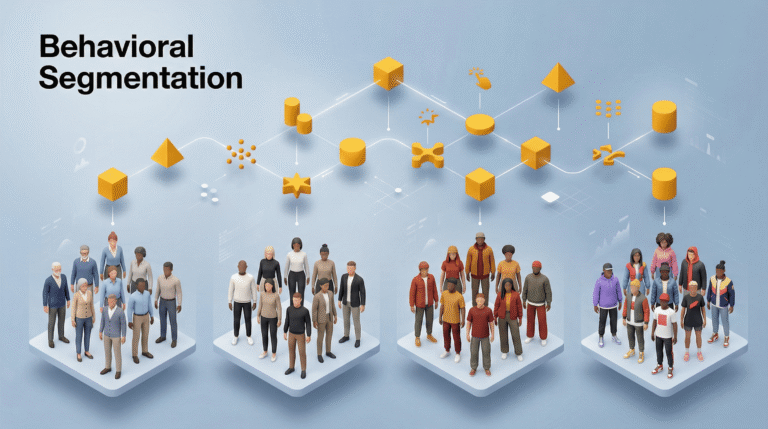
Behavioral segmentation
Behavioral segmentation groups customers based on their behavior. That includes:
-
Engagement frequency
-
Purchase cadence
-
Channel response
-
Lifecycle stage
As an example: Two customers may spend the same amount annually, but one buys consistently every month, while the other buys once during a deep promotion and disappears. While their revenue looks identical, their behavior is vastly different.
Value-based segmentation
Value-based segmentation ranks customers by what they contribute, not what they buy. It typically uses contribution margin, CLV, or profitability after cost to serve.
A classic example appears in subscription businesses. Enterprise customers may generate large contracts but require heavy onboarding and dedicated support. Mid-market customers may generate smaller contracts but deliver higher margins and faster payback. Without value-based segmentation, both groups get treated as “top customers.”
This framework is foundational for:
-
Budget allocation
-
Acquisition strategy
-
Deciding which customers not to chase
Needs-based segmentation
Needs-based segmentation groups customers by their motivations and intentions.
For example, in the CPG industry:
-
One segment prioritizes speed and convenience.
-
Another prioritizes trust and long-term stability.
-
A third may be price-sensitive and switch frequently.
Since each group requires different messaging, treating them uniformly leads to generic marketing that resonates with no one.
Psychographic segmentation
Psychographic segmentation looks at attitudes, beliefs, and values. It’s often overused in branding decks and underused in decision systems.
On its own, psychographic data is fragile. But when paired with behavior and value, it becomes powerful.
For example:
-
Customers who value sustainability may accept higher prices if the product experience reinforces that belief.
-
Customers who value novelty may churn faster but respond well to frequent product launches.
The key is not the label, but whether those attitudes predict measurable differences.
Related: Psychographics vs. Demographics in GTM Strategy
Hybrid models
The most effective segmentation models combine multiple lenses. A hybrid framework might include:
-
Behavioral signals (purchase frequency, channel response)
-
Value metrics (margin, CLV)
-
Needs or intent indicators
For example, a retailer might identify: “High-margin, high-frequency customers who respond to email but not paid social.”
That segment is immediately actionable. It tells you where to spend, how to message, and what to avoid.
Turning segmentation insights into action
Segmentation only earns its keep when it changes spend, messaging, or product decisions.
Media and budget allocation
Once segments are ranked by profitability and responsiveness, media plans are no longer averaged across the entire customer base.
For example:
-
High-value, high-retention segments may justify higher CAC thresholds.
-
Low-margin segments only make sense in low-cost channels or organic programs.
This prevents the common mistake of optimizing spend toward volume while diluting profit.
Creative and messaging strategy
Importantly, different segments respond to different signals.
A behaviorally defined segment that buys quickly may respond to urgency and availability. A high-consideration segment may need proof points, reviews, or guarantees.
Pricing and product strategy
Value-based segments often reveal pricing mismatches.
For example:
-
High-service, low-margin customers may require pricing adjustments or packaging changes.
-
High-margin segments may tolerate higher prices or premium tiers without churn.
Connecting customer segmentation to measurement and MMM
Segmentation becomes most powerful when it’s embedded into how performance is measured, not layered on after the fact.
Using segments inside MMM and attribution
In advanced measurement systems, segments become inputs.
-
In marketing mix modeling, segments can be introduced as explicit variables or modeled separately to reveal how different customer groups respond to spending. A channel that appears efficient in aggregate may perform well only for a narrow, high-value segment, while underperforming elsewhere. Without segmentation, that nuance disappears into averages.
-
In attribution models, segmentation acts as a filter to ask, “Which channel drove this conversion for this type of customer?”, especially when different segments follow different paths to purchase.
For example, a beauty brand may find that loyal customers convert primarily through email and organic search, while new customers rely on paid social, creator content, and promotional offers. Whereas a B2B SaaS company may find that enterprise buyers convert primarily through content and outbound sales, while SMB customers rely on paid search and free trials.
Attribution at the customer level (Beauty) or account level (B2B SaaS) surfaces these differences; segmentation makes them actionable.
Designing experiments by segment
Segmentation also sharpens experimentation. Rather than testing a single strategy across the entire audience, teams can run incrementality tests or geo experiments within specific segments.
Linking audience value to ROI
When segmentation is connected to MMM and experimentation, ROI becomes audience-aware.
Instead of reporting a 2.5x ROAS, teams can see that paid social delivers a 4x return for high-margin repeat customers and a sub-1x return for discount-driven first-time buyers. That insight changes media planning, budget allocation, creative strategy, and growth priorities.
Common pitfalls in segmentation
Most often, segmentation fails not because the data is wrong, but because the logic stops short of decisions. Consider the following common pitfalls:
-
Relying solely on surface-level demographics – Age, gender, and location are easy to segment on. They’re also rarely decisive. Two customers of the same age can behave very differently, and treating them as a single segment obscures the economic reality.
-
Having too many segments to act on – Teams often build dozens of micro-segments, each statistically interesting but operationally useless. When every segment requires a different strategy, none get executed well.
-
Ignoring financial signals – Revenue-heavy segments often look attractive until margin and cost-to-serve are applied. A customer segment that generates high topline but requires deep discounts, returns, or manual support may destroy profit over time.
-
Treating segmentation as static – Segments must be revisited as pricing, acquisition mix, or product offerings change. Otherwise, yesterday’s “high-value” group becomes tomorrow’s drag on performance.
Building a durable segmentation framework with fusepoint
When every customer looks active, it’s easy to mistake motion for progress. Here, segmentation brings clarity by revealing where value is concentrated and how it evolves.
At fusepoint, segmentation is always treated as a living system. This helps teams:
-
Unify CRM, transaction, and media signals into a single view of the customer
-
Anchor segments to margin and lifetime value rather than surface metrics
-
Pressure-test those definitions through experimentation.
As a result, you get segmentation that describes your customers and actively guides how you allocate spend over time.
If your current segmentation tells you who your customers are, but not how to grow profitably with them, it’s time to rebuild your framework with a strategic marketing consultancy that offers brand messaging services. Contact fusepoint today to get started.
Sources:
KPMG. Transforming Your SaaS Business. https://assets.kpmg.com/content/dam/kpmg/pdf/2016/07/transforming-saas.pdf
ScienceDirect. Customer segmentation analysis with big data in health services companies in Colombia: case study. https://www.sciencedirect.com/science/article/pii/S1877050925008877
ResearchGate. Moving to subscriptions: service growth through business model innovation in consumer and business markets. https://www.researchgate.net/publication/381656343_Moving_to_subscriptions_service_growth_through_business_model_innovation_in_consumer_and_business_markets
ScienceDirect. Customers who value sustainability may accept higher prices if the product experience reinforces that belief. https://www.sciencedirect.com/science/article/pii/S0148296321005889
Our Editorial Standards
Reviewed for Accuracy
Every piece is fact-checked for precision.
Up-to-Date Research
We reflect the latest trends and insights.
Credible References
Backed by trusted industry sources.
Actionable & Insight-Driven
Strategic takeaways for real results.
Emily Sullivan is an experienced marketing professional with over a decade of expertise in content creation, communications, and digital strategy. She thrives on translating complex, technical subject matter into content that is approachable, insightful, and genuinely useful to marketing professionals navigating a fast-evolving landscape.