




Why Bayesian Marketing Mix Modeling is the Future of Measurement

Emily Sullivan is an experienced marketing professional with over a decade of expertise in content creation, communications, and digital strategy. She thrives on translating complex, technical subject matter into content that is approachable, insightful, and genuinely useful to marketing professionals navigating a fast-evolving landscape.

Ben Dutter is Chief Strategy Officer at Power Digital and founder of fusepoint, a data and strategy consultancy powered by deep marketing intelligence. He’s spent nearly 20 years driving growth for brands like Amazon, Crocs, and Liquid Death, with a focus on ethical, effective, data-driven marketing.

- 1. Why traditional MMM falls short
- 2. What is Bayesian marketing mix modeling?
- 3. Inside the mechanics: Priors, posteriors, and distributions
- 4. Real-world advantages for marketers
- 5. How Bayesian MMM connects to incrementality testing
- 6. Implementation considerations
- 7. Why Bayesian MMM is the next step forward

Every marketer relies on one constant: The market never stops changing. Yet most measurement systems are built on the opposite assumption: that the past is stable enough to predict the future with a single, static model.
Traditional marketing mix models freeze the past into a single set of coefficients, producing a notion of truth. It’s tidy, but it rarely reflects how markets behave. In reality, channels can shift, and signals may degrade. A model that can’t adapt eventually stops describing reality.
Bayesian Marketing Mix Modeling changes that. It treats measurement as something that should evolve as new information is available. Instead of forcing certainty where none exists, it quantifies uncertainty, shows its work, and updates its predictions as conditions change.
Done right, it provides marketers with what traditional models can’t: A measurement system that supports decisions with confidence rather than hope.
Why traditional MMM falls short
Traditional marketing mix models were built for a static world, relying on fixed coefficients.
-
The biggest limitation is rigidity. A frequentist MMM produces one set of parameters and treats them as timeless truths. If paid social suddenly becomes more expensive, or if a privacy update wipes out half your data, the model won’t adjust until the next rebuild. In categories like e-commerce or subscription services, that lag can misguide budgets for an entire quarter.
-
Another issue is false precision. Traditional MMM reports exact elasticity estimates without expressing how uncertain those numbers actually are. In reality, the model may be concluding incomplete or noisy signals.
-
Data gaps make this worse. As privacy rules tighten and platforms obscure more user-level detail, traditional MMMs lose access to the granular signals they depend on. Google’s discontinuation of third-party cookies and Meta’s post-ATT limitations have both created blind spots that static models can’t fill.
Frequentist MMMs offer a snapshot of the past, but they can’t evolve with the market. However, Bayesian MMM exists to solve that gap.
What is Bayesian marketing mix modeling?
Bayesian marketing mix modeling starts with a simple premise: Your model should learn the way your team does.
Instead of producing a single, fixed answer, Bayesian MMM uses probability to express what the data suggests, how confident the model is, and how that belief should change as new evidence arrives.
Continuously learning and adjusting
Bayesian models ask: “Given what we already knew, and what the new data suggests, what’s our best estimate now?”
Because of this:
-
They can adapt to shifting elasticities, like when a channel suddenly drops or an ad format saturates faster than expected.
-
They reduce reliance on brittle assumptions by instead modeling a probability distribution around each parameter (“We believe channel X’s elasticity is between 0.8-1.2, given what we’ve done so far”).
For brands operating in volatile environments (think rapid platform policy changes or new privacy rules), this adaptability is what keeps measurement credible.
Bringing prior knowledge to bear
By design, Bayesian MMM allows you to start the model from a reasonable point rather than from zero. That “somewhere” might be: historical elasticity from last year, known saturation effects, benchmark performance from peers. It’s what the statistical world calls a “prior.”
For instance, if the last five years of data show search ads deliver an elasticity of around 0.9, you can set a prior around that instead of letting the model wander wildly. When new media formats arrive (such as short-form video), the model uses prior and current data to update the estimate effectively.
Quantifying uncertainty
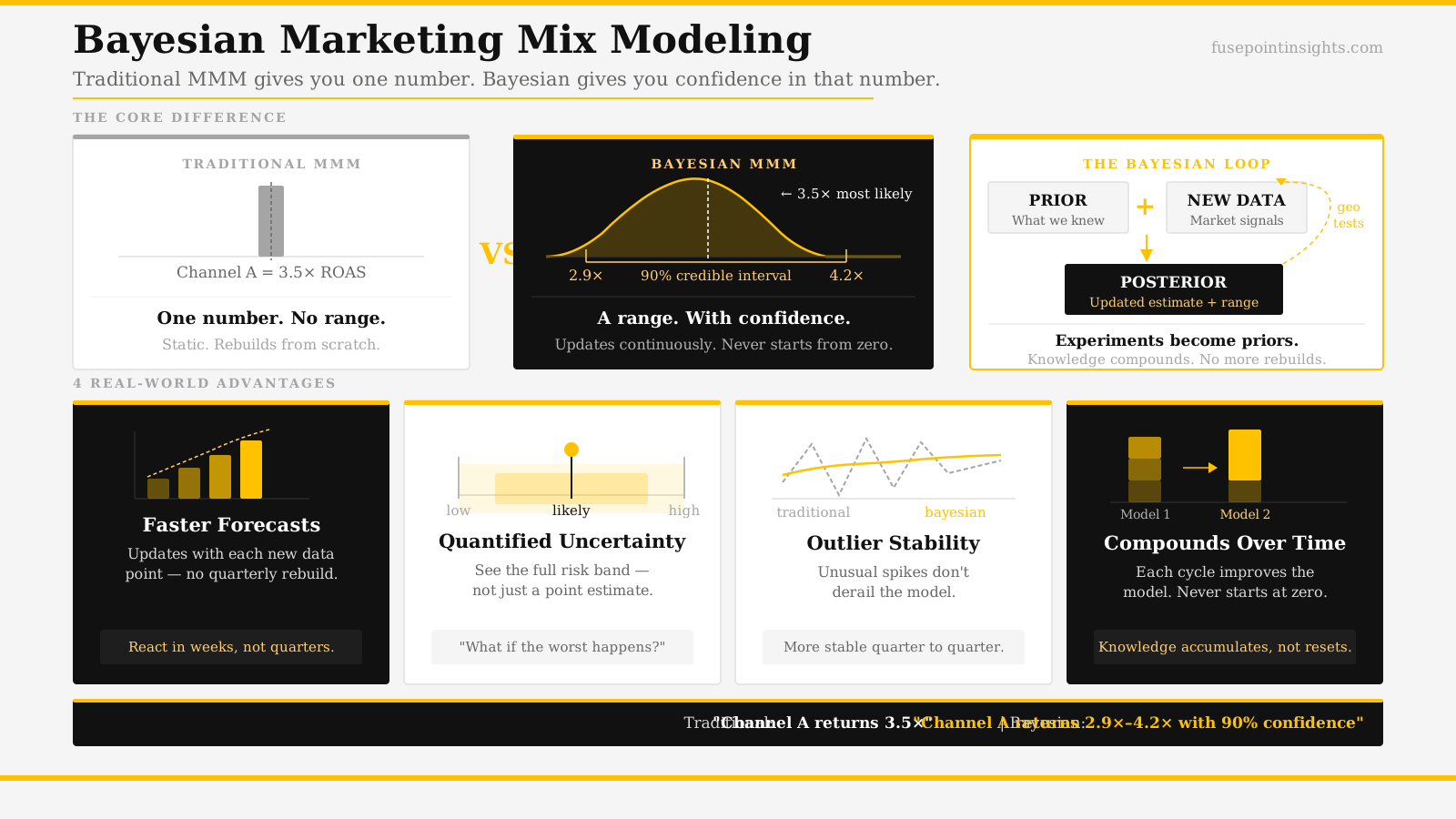
One of the largest improvements Bayesian MMM brings is not higher accuracy per se, but clearer confidence. Traditional models might simply state, “Channel A returns 3.5x ROAS.” Bayesian models might tell you: “Channel A returns between 2.9x and 4.2x with 90% probability.”
Decisions rarely rest on the point estimate alone. Leadership needs to understand the risk band; the “what if the worst happens” scenario. A model with quantified uncertainty:
-
Enables scenario planning with real numbers (“If ROAS dips to 2.9x, we could lose $X profit this year”).
-
Builds trust in measurement by showing what the model isn’t sure about, thereby making the output more defensible in boardroom scrutiny.
Inside the mechanics: Priors, posteriors, and distributions
To non-technical stakeholders, Bayesian mechanics can sound intimidating. However, the logic is intuitive. You begin with what you know, combine it with new evidence, and refine your perspective.
The three core pieces are: priors, likelihood, and posteriors.
-
Priors represent your existing knowledge or assumptions before seeing the latest data. That prior becomes the starting belief.
-
Likelihood is how new data updates those priors. When you collect performance data, it tells you how plausible different outcomes are.
-
Posterior is the updated belief after combining the prior and the likelihood. It presents your best estimate, taking into account experience and new data, along with a range of uncertainty.
As an example, let’s say a brand believes paid social will deliver 2.5× ROAS (prior). After two months, they see early returns of 1.8× and a rising saturation rate. The Bayesian update moves the estimate down, but not ignorantly: It shifts to something like “we now estimate ROAS 1.6×-2.2× with 90 % confidence” (posterior).
Real-world advantages for marketers
Importantly, the mechanics translate directly to business advantage. Here are the practical outcomes you can gain when Bayesian MMM is done right:
-
Faster, more reliable forecasts – When modeling adapts with each new data point, budget planners no longer wait months for the next refresh. They get updated channel impact ranges and can react more quickly.
-
Quantified uncertainty – Instead of “Channel A returns 3×,” you get “Channel A returns between 2.4× and 3.8× with 95 % credibility.” That helps executives weigh risk.
-
Reduced volatility from outliers – Traditional models can swing wildly when unusual spikes or drops appear. Bayesian models temper that by anchoring estimates in prior knowledge and distributions, making them more stable.
-
Incremental updates, not rebuilds – Because you start with priors and accumulate evidence, you don’t need to throw away the model every time business conditions shift.
How Bayesian MMM connects to incrementality testing
Bayesian MMM becomes significantly more powerful when paired with experimentation. Incrementality experiments for marketing measurement produce some of the cleanest causal signals available in marketing, which Bayesian models can use as priors.
Think of it as a feedback loop:
-
Run an incrementality experiment (such as a geo-split for paid social).
-
Use the measured lift from that test as a prior in the Bayesian MMM, anchoring the channel’s elasticity to real causal evidence.
-
As MMM ingests new data, the posterior updates, refining the channel’s impact estimate.
-
Future experiments feed back into the model, continually improving accuracy.
This creates a measurement system where experiments validate the model, and the model identifies where experiments are most needed. It’s the opposite of siloed attribution or MMM built in isolation.
Implementation considerations
Bayesian MMM is more adaptive and robust, but it does require a stronger analytical foundation. The payoff is long-term durability and far higher trust in the outputs.
Clean, structured historical data
At least two years of weekly or daily data is ideal, including marketing spend, conversions, revenue, pricing, promotions, and external factors.
Without clean inputs, the model will spend more time correcting noise than revealing signal, since messy data is the biggest barrier to media mix modeling.
Well-defined priors
Priors work best when grounded in real evidence. Sources may include:
-
Lift results from geo experiments
-
Known elasticity ranges from previous MMMs
-
Channel performance benchmarks across similar industries
These guardrails help prevent the model from overreacting to short-term volatility.
Computational capability
Bayesian MMM involves sampling thousands (sometimes millions) of parameter distributions. It’s more computationally intensive than frequentist methods.
Data science readiness
Bayesian modeling requires statistical judgment: setting priors, interpreting posterior ranges, and recognizing when uncertainty is meaningful rather than problematic.
Most modern data teams already have the foundation. Now, they simply need frameworks to guide their decisions.
Why Bayesian MMM is the next step forward
Marketing teams can’t afford models that age the moment conditions change. A measurement system built on static assumptions will always fall behind a market defined by uncertainty.
However, Bayesian MMM answers that reality head-on. It updates as the world changes, tying measurement more closely to the financial outcomes leaders actually manage against.
At fusepoint, we see Bayesian MMM as the next logical evolution of durable measurement. It’s how brands build forecasting systems that stay accurate longer and stand up to both experimentation and the boardroom.
We integrate it into a broader measurement ecosystem built around three pillars:
-
Bayesian modeling that updates as markets change, rather than forcing decisions based on outdated coefficients.
-
Incrementality testing that grounds priors in causal evidence and validates posterior results in the real world.
-
Profitability frameworks that tie every lift estimate back to CAC, CLV, and margin, ensuring the output holds up under financial scrutiny.
It’s this combination of adaptive math and experimentation that makes Bayesian MMM more than a modeling upgrade. Instead, it becomes a strategic asset: a system that leadership can trust while planning.
If your current measurement framework feels brittle or backward-looking, it’s a sign that your model isn’t keeping up with your market. Partner with a marketing science company like fusepoint to start replacing your static answers with a living measurement system.
Our Editorial Standards
Reviewed for Accuracy
Every piece is fact-checked for precision.
Up-to-Date Research
We reflect the latest trends and insights.
Credible References
Backed by trusted industry sources.
Actionable & Insight-Driven
Strategic takeaways for real results.
Emily Sullivan is an experienced marketing professional with over a decade of expertise in content creation, communications, and digital strategy. She thrives on translating complex, technical subject matter into content that is approachable, insightful, and genuinely useful to marketing professionals navigating a fast-evolving landscape.