



Target audience analysis: What it is & how to do it

Emily Sullivan is an experienced marketing professional with over a decade of expertise in content creation, communications, and digital strategy. She thrives on translating complex, technical subject matter into content that is approachable, insightful, and genuinely useful to marketing professionals navigating a fast-evolving landscape.

Ola Wolski is a marketing research professional with nearly seven years of experience in social media strategy, innovative research, and data-driven marketing measurement. She thrives on digging into complex data to surface the clear, actionable insights that help brands measure what matters and invest with confidence in a rapidly evolving digital landscape.

- 1. What is a target audience analysis?
- 2. Why target audience analysis matters for performance and data accuracy
- 3. Core components of target audience analysis
- 4. How to do a target audience analysis step by step
- 5. How target audience analysis fits into modern measurement systems
- 6. Defining the audience on which growth is built

Standing in a crowded room, you’re asked to identify the exact people you want to speak to. You start by asking, “Raise your hand if you work in marketing.”
As several hands go up, you narrow your question to “Keep your hand raised if you manage paid media budgets.”
Some more hands drop. Next, you ask, “Keep your hand up if you’re responsible for a $5M+ annual spend.”
Now the room looks different, because the audience data has sharpened.
Target audience analysis works the same way. It narrows a broad market into the specific cohort most likely to convert, retain, and generate profitable lifetime value.
Yet many organizations skip this step. They jump straight into campaign optimization without validating who their strategy is actually built for. The result is predictable: higher acquisition costs, weaker conversion rates, and measurement systems analyzing noise instead of signal.
At fusepoint, we treat audience definition as a capital allocation decision. That’s because the cohort you pursue determines how efficiently growth compounds. Discover how to identify your cohort (and the benefits of doing so) in this comprehensive target audience analysis guide.
What is a target audience analysis?
Analysis of target audience refers to the structured evaluation of the demographic, psychographic, behavioral, and needs-based characteristics of the customers most likely to generate sustainable revenue and lifetime value.
Put simply, it’s the disciplined process of identifying the specific customer segments a business should prioritize for growth.
Many companies assume this work happens naturally through general market research. In reality, the two disciplines serve different purposes.
- Market research answers a broad question: Who exists in the market?
- Target audience analysis answers a more strategic question: Who should we pursue?
Markets are rarely homogeneous. Within the same category, some customers convert quickly, retain longer, and purchase at higher margins. Others may interact briefly or require costly incentives to engage. Without separating those groups, growth strategies drift toward the average customer, which is often the least economically attractive.
Target audience analysis narrows the field by evaluating traits tied directly to measurable outcomes. This process builds on the foundation of market segmentation analysis, which identifies the distinct groups within a market.
Target audience analysis then applies a financial lens to determine which of those segments deserve the most investment. The analysis becomes more valuable when financial metrics enter the equation.
- Some cohorts generate stronger lifetime value because they purchase repeatedly or expand usage over time.
- Others carry higher contribution margins because they require less discounting, support, or sales intervention.
When these patterns are visible, marketing strategy shifts from chasing broad reach to prioritizing the segments where growth compounds most efficiently.
fusepoint’s customer research services formalize this process by combining demographic, psychographic, and behavioral analysis into structured audience frameworks that connect customer characteristics directly to revenue outcomes.
Why target audience analysis matters for performance and data accuracy
At its core, audience definition determines how efficiently marketing spend translates into revenue.
When audience targeting aligns with high-fit customers, conversion rates improve because the offer matches genuine demand. The same media budget generates more qualified traffic, lowering cost per acquisition.
Conversely, broad or poorly defined targeting introduces noise. Campaigns reach large numbers of people who have little interest in the product, forcing platforms to spend more impressions to generate the same number of conversions.
- Industry benchmarks illustrate how sensitive performance can be to relevance. Research analysis of Google Ads accounts found that the average search conversion rate across industries is about 4.4%, but high-intent verticals regularly achieve significantly higher rates when targeting closely matches user intent.
- Better audience alignment also improves retention. Customers who match the intended value proposition are more likely to remain engaged after purchase, strengthening lifetime value and improving the LTV-to-CAC ratio that signals sustainable growth.
- Audience definition also plays a critical role in data quality. This is another reason why reaching your target audience is important in data analysis: Poorly defined audiences contaminate performance metrics. When high-value and low-value customers are blended, averages obscure the real drivers of profitability.
Data intelligence solutions address this problem by structuring and unifying customer data so that performance metrics can be analyzed at the segment level, ensuring that effective marketing decisions reflect the behavior of high-value cohorts rather than diluted market-wide averages.
Precise targeting improves the reliability of those systems. The financial outcomes follow naturally:
- Lower acquisition costs as campaigns reach higher-intent prospects
- Higher incremental return on ad spend because media investment generates more genuine demand
- Stronger LTV:CAC ratios as retention and expansion improve
In this way, target audience analysis serves as the foundation of accurate measurement. When the right customers are identified early, both marketing performance and analytical clarity improve at the same time.
fusepoint’s marketing performance consulting builds on this foundation by connecting audience definitions to the incrementality tests, mix models, and attribution frameworks that evaluate whether marketing investment is generating genuine demand within prioritized segments.
Core components of target audience analysis
Target audience analysis works when it evaluates customers across multiple dimensions. Understanding these dimensions is a key step in how to do a target audience analysis effectively.
Demographic analysis
Demographic analysis examines observable attributes such as age, income level, industry, company size, and geographic location. These traits are often the easiest to collect and frequently serve as the starting point for segmentation.
For example, a B2B software provider may discover that companies with 200 to 500 employees convert at significantly higher rates than smaller firms. Larger organizations may have greater budgets, clearer internal processes, and a stronger need for automation. The demographic insight informs sales outreach.
However, demographics alone rarely explain purchasing behavior. Two organizations in the same industry and size range can still make very different decisions depending on priorities and internal culture. Demographic data shows who customers are, but not necessarily why they buy.
Psychographic analysis
Psychographic analysis explores the motivations and beliefs that influence decision-making. These factors include risk tolerance, aspirations, attitudes toward innovation, and underlying value systems.
Consider two marketing leaders evaluating the same analytics platform: One may prioritize experimentation and growth velocity, while another may prioritize operational stability and risk mitigation.
In a demographics vs psychographics comparison, their profiles may be identical, yet their motivations (and therefore messaging triggers) differ significantly.
Now, psychographic insight shapes positioning. For example, messaging that resonates with an experimentation-driven audience may emphasize speed and testing capability. This layer often determines whether a brand feels aligned with its audience or interchangeable with competitors.
For a deeper look at how these motivational variables are structured and applied, our guide to psychographic segmentation breaks down the key dimensions, such as values, lifestyle, personality, attitudes, and how each one influences positioning and creative strategy.
Behavioral analysis
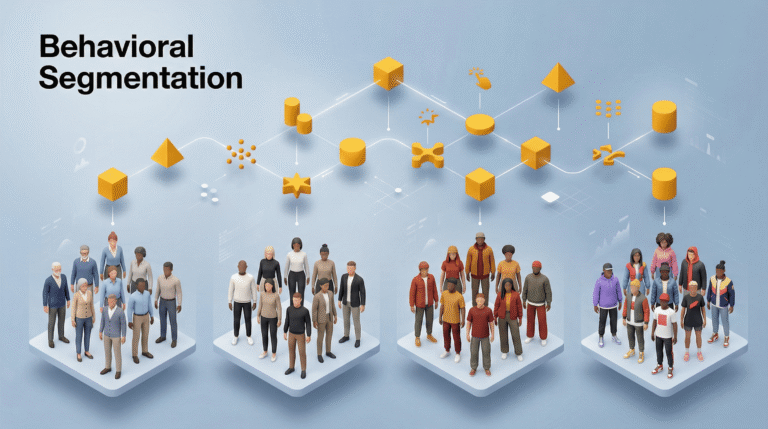
Behavioral segmentation examines what customers actually do rather than what they say. It focuses on measurable patterns such as:
- Purchase frequency
- Channel preference
- Engagement behavior
- Product usage
In e-commerce, behavioral patterns often reveal the most actionable insights. A retailer may find that customers who arrive through organic search complete purchases at a much higher rate than those from display campaigns. Another pattern may show that customers who interact with product reviews or comparison guides convert more reliably than those who browse casually.
Because behavior reflects real actions rather than stated intent, it often carries the strongest predictive power.
Needs and outcome analysis
Needs-based analysis focuses on the problems customers are trying to solve and the outcomes they value most. These needs can be functional, emotional, or strategic.
- Functional needs relate to practical outcomes. For example, a logistics platform may help businesses reduce shipping costs or improve delivery reliability.
- Emotional drivers often revolve around confidence, trust, or perceived status.
- Strategic outcomes may include gaining a competitive advantage or scaling operations more efficiently.
Understanding these needs reveals the tradeoffs customers are willing to make.
| Component | What It Reveals | Strategic Application |
|---|---|---|
| Demographic | Observable traits | Targeting and media planning |
| Psychographic | Motivations and beliefs | Messaging and positioning |
| Behavioral | Actions and usage | Retention and lifetime value modeling |
| Needs-Based | Core problems and goals | Offer design and differentiation |
When analyzed collectively, these signals can help organizations move beyond broad targeting and focus on the segments most likely to produce sustainable revenue.
How to do a target audience analysis step by step
Rather than starting with assumptions about the market, your organization should first understand the customers you already serve.
Step 1: Analyze existing customer data
Your initial objective with target audience analysis is to identify where revenue currently concentrates.
Key metrics here include revenue contribution by segment, lifetime value distribution, retention patterns, and contribution margin by cohort. These signals often reveal that a relatively small share of customers drives a disproportionate share of long-term value.
As a target audience analysis example, many subscription businesses find that a minority of users generate the majority of expansion revenue through upgrades and renewals. Understanding which segments those users belong to provides the foundation for audience prioritization.
A structured customer segmentation analysis formalizes this step by connecting revenue and retention patterns to specific customer profiles, ensuring that audience prioritization reflects actual financial contribution rather than assumptions about who the best customers are.
Step 2: Identify high-value consumer behavior patterns
Once the highest-value cohorts are identified, the next step is to examine what those customers have in common.
Patterns may appear across several dimensions. High-value customers may originate from specific acquisition channels, share similar company sizes or purchasing roles, or demonstrate consistent behavioral traits such as early product adoption.
These patterns reveal not only who your ideal customers are but also how they behave early in the relationship.
Step 3: Evaluate broader market opportunity
Effective audience analysis must also consider scale. A highly profitable segment is useful only if it exists in sufficient numbers to support growth.
Evaluating broader opportunities involves assessing total addressable segment size, competitive saturation, and growth potential. The TAM, SAM, SOM framework provides a structured approach to this evaluation, helping teams estimate the total addressable market, the serviceable portion they can realistically reach, and the share they can capture given current resources and competitive positioning.
If a segment produces strong margins but is extremely small, it may not support long-term expansion. Conversely, a larger segment with slightly lower margins may offer greater overall opportunity.
Step 4: Quantify segment attractiveness
Once candidate segments are identified, they must be evaluated using measurable performance criteria.
Important indicators include:
- Conversion rates
- Average order value or contract value
- Repeat purchase frequency
- Acquisition cost
Together, these metrics determine whether a segment produces sustainable unit economics.
Step 5: Translate audience insights into actionable personas
Customer insight services convert these results into clear segment definitions that can guide your strategy.
Each profile should clarify motivations, purchasing triggers, common objections, and the channels through which that audience prefers to engage.
For example, a high-value segment may consist of mid-sized companies seeking operational efficiency lrather than early-stage startups experimenting with new tools. Messaging, pricing, and product positioning can then be aligned with that audience’s priorities.
At this stage, audience analysis moves from research to execution. Marketing campaigns become more focused, sales teams pursue higher-probability prospects, and measurement systems track performance within clearly defined cohorts.
When done rigorously, target audience analysis ensures that growth strategies concentrate on the customers most capable of sustaining long-term value.
How target audience analysis fits into modern measurement systems
Within a modern measurement system, audience analysis answers a foundational question: Which customers should your business prioritize?
- Customer lifetime value modeling provides the first connection. Once audiences are segmented, you can calculate customer lifetime value to estimate how different cohorts contribute to revenue over time.
- Incrementality testing adds a second layer of validation. Experiments such as geo tests or holdout groups can measure whether marketing investments truly generate new demand within prioritized segments.
- Media mix modeling then connects actionable insight to media investment decisions. When audience analysis identifies high-value segments, mix models can help determine which channels most effectively reach those cohorts.
- Unified marketing measurement frameworks combine these elements. Attribution data shows immediate conversion paths, incrementality testing validates causal impact, and marketing mix modeling measures channel-level contribution. Audience analysis anchors the entire system by defining which customers you should pursue in the first place.
When these systems operate together, audience analysis becomes a structural input into how companies allocate capital.
Defining the audience on which growth is built
Growth rarely fails because there are no customers in the market. However, pursuing the wrong segment can make it difficult to achieve.
When the audience definition is vague, marketing activity spreads across too many segments at once. What appears to be growth on the surface often masks weak retention and declining margins underneath.
Target audience analysis corrects that drift. By identifying the audience segment most capable of converting, retaining, and expanding over time, organizations can shift from chasing volume to building durable demand.
At fusepoint, audience analysis is integrated with lifetime value frameworks, incrementality testing, and marketing mix modeling to ensure that segmentation decisions translate directly into capital allocation strategy. The objective is not simply to describe your customer base, but to build growth systems around the ones who matter most.
When the right audience profile is defined early, everything else compounds in the right direction. Contact us today to see how we can help your team focus on the customers most capable of driving durable, profitable growth through your marketing efforts.
Sources:
InTechOpen. International Market Segmentation across Consumption and Communication Categories: Identity, Demographics, and Consumer Decisions and Online Habits. https://www.intechopen.com/chapters/70488
WordStream. Google Ads Benchmarks for YOUR Industry [Updated!]. https://www.wordstream.com/blog/ws/2016/02/29/google-adwords-industry-benchmarks
MDPI. Personality or Value: A Comparative Study of Psychographic Segmentation Based on an Online Review Enhanced Recommender System. https://www.mdpi.com/2076-3417/9/10/1992
Springer. Time analysis of online consumer behavior by decision trees, GUHA association rules, and formal concept analysis. https://link.springer.com/article/10.1057/s41270-023-00274-y
Our Editorial Standards
Reviewed for Accuracy
Every piece is fact-checked for precision.
Up-to-Date Research
We reflect the latest trends and insights.
Credible References
Backed by trusted industry sources.
Actionable & Insight-Driven
Strategic takeaways for real results.
Emily Sullivan is an experienced marketing professional with over a decade of expertise in content creation, communications, and digital strategy. She thrives on translating complex, technical subject matter into content that is approachable, insightful, and genuinely useful to marketing professionals navigating a fast-evolving landscape.