



What is a buyer persona? Definition, examples, and template

Emily Sullivan is an experienced marketing professional with over a decade of expertise in content creation, communications, and digital strategy. She thrives on translating complex, technical subject matter into content that is approachable, insightful, and genuinely useful to marketing professionals navigating a fast-evolving landscape.

Ola Wolski is a marketing research professional with nearly seven years of experience in social media strategy, innovative research, and data-driven marketing measurement. She thrives on digging into complex data to surface the clear, actionable insights that help brands measure what matters and invest with confidence in a rapidly evolving digital landscape.

- 1. What is a buyer persona?
- 2. What is a buyer persona in marketing?
- 3. What to include in a buyer persona
- 4. How to create a buyer persona
- 5. Buyer persona example
- 6. From buyer personas to data-driven customer segmentation
- 7. How buyer personas fit into modern marketing measurement
- 8. Where personas become a growth system

Picture this: A sculptor looks at the form he wants to represent and starts with a rough structure. Then, he layers in depth: first the frame, then the muscle, then the fine details that give the figure its shape and realism. Each layer brings the subject closer to something recognizable and precise.
Buyer personas should be built the same way.
Yet in many organizations, personas are treated as surface-level sketches: a few demographic traits, a job title, a list of assumed goals. Then, teams move on to execution. Campaigns launch, channels are optimized, and performance is evaluated, all on top of an incomplete understanding of who the customer actually is.
That gap shows up quickly in imprecise messaging and stalled conversion rates, because the underlying assumptions about the customer were never fully developed.
But when buyer personas are grounded in real data, they can align marketing, sales, and product teams around the same customer reality, leading to deeper segmentation and measurement.
What is a buyer persona?
A buyer persona is a semi-fictional representation of a company’s ideal customer based on research, behavioral data, and observed purchasing patterns.
The term “semi-fictional” is often misunderstood. Far from being invented profiles, personas are compressed models of real customer behavior, built from patterns observed across data and research.
At their best, buyer personas answer a set of practical questions:
- Who is most likely to buy?
- What problem are they trying to solve?
- How do they evaluate options?
- What triggers action, and what causes hesitation?
They bring structure to what would otherwise be fragmented insight. In fact, a well-built persona captures multiple layers of information:
- Demographics or firmographics – Age, income, role, company size, geography
- Goals and motivations – What the customer is trying to achieve
- Pain points and challenges – Constraints, frustrations, unmet needs
- Buying triggers – Events or conditions that initiate consideration
- Information sources and decision process – Where they research and how they decide
For example, two customers purchase the same product but for different reasons. One may be motivated by price efficiency, and the other by reliability or brand trust. Here, a single “average customer” profile would obscure that difference. Understanding what drives these differences often requires looking beyond observable traits. Psychographic segmentation provides a framework for categorizing customers by values, attitudes, and motivations — the deeper layers that give buyer personas their explanatory power.
What is a buyer persona in marketing?
In marketing, buyer personas function as a decision filter. They shape how messages are written, where campaigns are deployed, and which audiences are prioritized. Without them, teams often default to broad targeting and generic messaging.
At a practical level, personas improve:
- Messaging alignment – Different customers respond to different value propositions. For example, a cost-focused persona may respond to efficiency messaging, while a premium persona may respond to quality or reliability.
- Campaign targeting – Personas define which audiences to pursue and which to deprioritize. This reduces wasted spend and improves conversion efficiency.
- Content strategy – Understanding how customers gather information, like reviews, comparisons, and social proof, guides what content to create and where to distribute it.
- Product positioning – Personas reveal how customers frame the category. This influences how products are described, differentiated, and priced.
For example, a B2C subscription service may identify two core personas:
- A value-driven user focused on affordability and basic functionality
- A power user focused on advanced features and performance
Marketing campaigns, landing pages, and pricing tiers can then be tailored to each persona rather than attempting to serve both with a single message.
And the value of personas extends beyond marketing:
- Sales teams use them to anticipate objections, tailor conversations, and shorten decision cycles.
- Product teams use them to prioritize features that align with real customer needs.
- Growth teams use them to connect acquisition strategy with retention and lifetime value outcomes.
When these cross-functional applications are coordinated, personas serve as a foundation for go-to-market strategy consulting, aligning audience definition, messaging, and channel planning around a unified customer model.
What to include in a buyer persona
What to include in a buyer persona depends on the decisions it needs to inform across marketing, product, and sales.
Because a useful buyer persona is a structured model of decision behavior, each component should answer a specific question that informs targeting, messaging, or product strategy.
Demographic or firmographic information
This can include:
- Age, location, income, and education level
- Job title, industry, company size (for B2B)
This layer defines who the customer is in observable terms. Its primary role is to support targeting and segmentation, not to explain motivation.
Goals and objectives
Goals provide context for decision-making, such as:
- What the customer is trying to accomplish
- Functional or emotional outcomes they seek
This component directly informs messaging and positioning, determining which benefits should lead.
Pain points and barriers
Pain points explain why action is taken, while barriers explain why it’s delayed or avoided.
For example, a customer may want a premium product but hesitate due to price uncertainty or lack of trust. This component shapes both product strategy and content strategy, especially around objection handling.
Decision drivers
Decision drivers determine how customers compare options. Identifying these drivers clarifies what actually wins the purchase decision.
This component is central to conversion optimization: It informs how offers are framed, how comparisons are structured, and what proof points are emphasized. When decision drivers vary significantly across customers, benefit segmentation can formalize those differences. Grouping audiences by the specific outcomes they prioritize rather than by who they are demographically.
Information sources
Information sources determine where and how customers gather evidence before deciding.
For example, a customer who relies heavily on peer reviews requires strong social proof. Another who depends on expert content may respond better to detailed product explanations.
| Persona Component | What It Reveals | Strategic Use |
|---|---|---|
| Demographics | Who the customer is | Targeting and segmentation |
| Goals | What they want to achieve | Messaging and positioning |
| Pain Points | Problems they need solved | Product and content strategy |
| Decision Drivers | What influences purchase | Conversion optimization |
| Information Sources | Where they research | Channel strategy |
Together, these components form a coherent view of how demand is created and captured.
How to create a buyer persona
How to build a buyer persona requires combining qualitative insights with quantitative performance data.
Step 1: Analyze existing customer data
Start with what you already know. For instance:
- Customer demographics or firmographics
- Purchase frequency and product usage patterns
- Revenue concentration by segment
This step identifies which customers matter most economically. High-value segments should anchor persona development, not average users.
Step 2: Conduct customer research
Customer research services explain the behavior hidden behind data.
- Interviews uncover motivations, decision logic, and objections
- Surveys quantify preferences, priorities, and willingness to pay
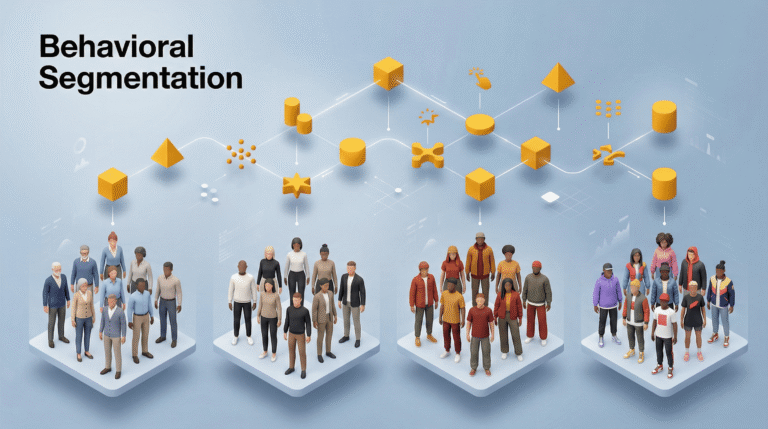
Step 3: Identify behavioral patterns
Look for consistent patterns across high-performing customers.
- What characteristics do they share?
- How do they differ from low-value or low-conversion segments?
- Which channels and messages drive their behavior?
This behavioral segmentation separates signal from noise.
Step 4: Build persona profiles
Translate patterns into structured profiles.
- Summarize key attributes (who they are)
- Define motivations and goals (what they want)
- Document pain points and barriers (what stops them)
- Outline decision drivers and triggers (what moves them)
- Map information sources (where they engage)
The goal here is clarity. Personas should be usable in decision-making, not just descriptive.
Step 5: Validate and refine
Importantly, personas are only hypotheses until they’re validated. The final step is to:
- Compare persona assumptions with real campaign performance
- Test messaging against defined personas
- Monitor whether targeted segments convert and retain as expected
For example, if a persona predicts high value but performance data shows low retention, the model needs adjustment.
Put simply, how to make a buyer persona means translating observable user patterns into a structured, usable profile.
Buyer persona example
Now that you know what is the definition of a buyer persona, consider a persona like an Operational Efficiency Manager: a mid-level leader responsible for improving processes without increasing risk or cost. On paper, that description may seem simple, but the decision context in real life is far from it.
This persona operates under constraint. Their budgets are limited, expectations are high, and any change carries operational risk. As a result, their decisions are not driven by novelty or features, but by certainty of outcome. They’re less interested in what a product can do and more concerned with whether it’ll deliver measurable improvement without disruption.
That changes how strategy is executed.
Messaging must demonstrate a specific, quantifiable impact. Content teams will target them with social proof like case studies, because credibility matters more than creativity. In sales conversations, the focus moves to implementation: how quickly the solution can be deployed, what risks exist, and how results will be measured.
From buyer personas to data-driven customer segmentation
Traditional persona frameworks are descriptive. They summarize characteristics, motivations, and challenges, often based on limited research or internal assumptions. While they’re useful for alignment, they struggle to answer a more important question: How much does this persona matter to the business?
This is where customer segmentation analysis comes into play. Instead of treating personas as standalone profiles, modern approaches connect them to observable data. For example, a persona defined as “price-sensitive” becomes more actionable when the organization understands:
- How large the segment is
- How it converts
- How it retains
- Whether it produces a sustainable margin
The outcome is fewer, more meaningful segments, each tied to economic performance. Targeting becomes more precise, not just because messaging improves, but because the organization is focused on the right cohorts to begin with.
How buyer personas fit into modern marketing measurement
On their own, metrics like conversion rate or return on ad spend are incomplete, because they don’t show crucial context. Personas introduce that missing layer.
When integrated properly, they sit upstream of measurement frameworks:
- They inform target audience definitions, which shape how market segmentation analysis models are built.
- When you calculate customer lifetime value, buyer personas reveal which customers translate into long-term revenue.
- Marketing mix models show how different segments respond to channel investment.
- Incrementality testing validates whether targeting a specific persona actually drives new demand or simply captures existing intent.
The result is a closed loop: Personas define expectations about behavior, and measurement systems test those expectations against reality. The gap between the two becomes an invaluable source of insight.
Where personas become a growth system
When grounded in real data, buyer personas bring clarity to how customers think, what they value, and what drives action. They align marketing, sales, and product teams around a shared understanding of the customer. And when connected to segmentation and performance data, they predict where growth will occur.
Over time, data-based buyer personas can help you build a marketing framework that supports more consistent, reliable growth. And fusepoint can guide the way.
Contact fusepoint today to get started with persona development services.
Sources:
ScienceDirect. Data-Driven Personas for Enhanced User Understanding: Combining Empathy with Rationality for Better Insights to Analytics. https://www.sciencedirect.com/science/article/pii/S2543925122000560
ResearchGate. Are Personas Done? Evaluating Their Usefulness in the Age of Digital Analytics. https://www.researchgate.net/publication/328763585_Are_personas_done_Evaluating_their_usefulness_in_the_age_of_digital_analytics
ScienceDirect. Artificial intelligence in customer relationship management: A systematic framework for a successful integration. https://www.sciencedirect.com/science/article/pii/S0148296325003546
ResearchGate. Customer Segmentation Strategies in Emerging Markets: A Review of Tools, Models, and Applications. https://www.researchgate.net/publication/394014688_Customer_Segmentation_Strategies_in_Emerging_Markets_A_Review_of_Tools_Models_and_Applications
Our Editorial Standards
Reviewed for Accuracy
Every piece is fact-checked for precision.
Up-to-Date Research
We reflect the latest trends and insights.
Credible References
Backed by trusted industry sources.
Actionable & Insight-Driven
Strategic takeaways for real results.
Emily Sullivan is an experienced marketing professional with over a decade of expertise in content creation, communications, and digital strategy. She thrives on translating complex, technical subject matter into content that is approachable, insightful, and genuinely useful to marketing professionals navigating a fast-evolving landscape.