


Demographic segmentation explained: Definition, types, and examples

Emily Sullivan is an experienced marketing professional with over a decade of expertise in content creation, communications, and digital strategy. She thrives on translating complex, technical subject matter into content that is approachable, insightful, and genuinely useful to marketing professionals navigating a fast-evolving landscape.

- 1. What is demographic segmentation?
- 2. The seven types of demographic segmentation
- 3. Demographic segmentation examples in practice
- 4. Demographic vs psychographic, behavioral, and geographic segmentation
- 5. How to collect and validate demographic data
- 6. Connecting demographic segments to financial outcomes
- 7. Making segmentation a decision system with fusepoint
- 8. FAQs

A marketing team reviews a new campaign brief that clearly defines the audience: 25 to 34 years of age, urban, mid-income, digitally active. The targeting looks precise, and the creative follows suit. On paper, it feels complete.
But when the campaign launches, performance stalls, and engagement looks shallow. The audience was “right,” yet the outcome doesn’t follow. The problem here is the inherent incompleteness of demographic segmentation.
Demographics describe who is in a market. They don’t explain why anyone buys, what motivates a decision, or when a customer is ready to act. When treated as causal drivers instead of descriptive proxies, they create a false sense of precision, leading to overspend on low-intent audiences.
So, where do demographics fit, and where do they fall short? Discover what demographic segmentation actually measures, the core variables it relies on, how it interacts with behavioral and psychographic segmentation, and the common mistakes that may erode performance.
What is demographic segmentation?
Demographic segmentation is the practice of grouping a market into subgroups based on shared, observable population characteristics such as age, gender, income, education, occupation, family structure, ethnicity, and religion. This is the core demographic segmentation definition used across marketing and research.
What is demographic segmentation trying to do? It organizes a broad market into identifiable groups that can be reached and addressed at scale. The demographic segmentation meaning is therefore descriptive: it tells you who exists in a market, not how they behave within it.
This is where it differs from other approaches, especially demographic vs psychographic segmentation.
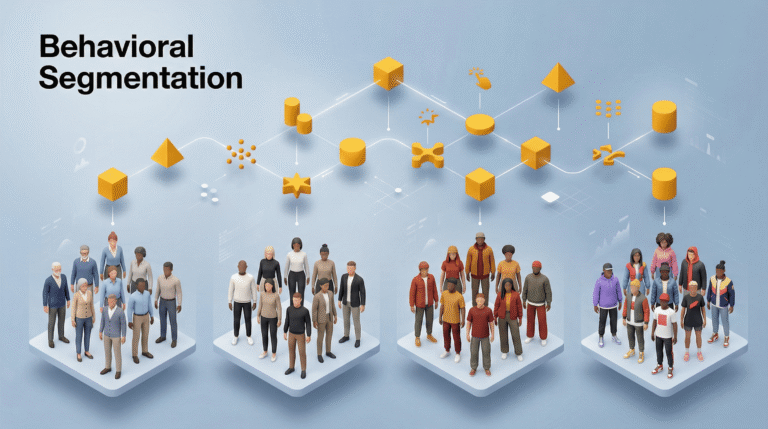
- Behavioral segmentation focuses on what people do, such as purchases, usage, and engagement.
- Psychographic segmentation examines what people believe and value.
- Geographic segmentation looks at where people live and how location shapes access or preference.
- Benefit segmentation identifies the specific outcomes or value customers seek from a product, regardless of who they are.
The demographic market segmentation definition sits upstream of these. It provides a structural view of the population: who is available to target, how large each group is, and how they can be accessed through media.
That utility explains its widespread use, since demographic data is relatively stable, easy to source, and simple to activate across platforms. But its limitation is just as clear: Two customers with identical demographics can behave entirely differently.
The seven types of demographic segmentation
The seven most common types of demographic segmentation are age, gender, income, education, occupation, family structure, and ethnicity or culture. Some models extend this to include religion, nationality, or generational cohorts.
While grouping audiences by shared, observable traits may seem straightforward at first, complexity emerges in the application. Take the classic demographic segmentation example of automotive marketing, where luxury brands often target higher-income, older professionals. However, brands like Tesla disrupted this pattern by attracting younger, tech-driven buyers across income bands, showing how behavior can override traditional demographic assumptions.
The takeaway is that each variable in demographic market segmentation provides context, but none should be treated as a standalone decision driver.
Age and generation
Age segmentation groups audiences by life stage or cohort, such as teens, young professionals, parents, and retirees. It’s often the first answer to what is demographic market segmentation, because it’s intuitive and widely available.
This type of segmentation works well in life-stage products and media alignment. For instance, streaming platforms like Netflix tailor content and recommendations partly based on age-linked viewing patterns, and financial products (student loans vs. retirement plans) naturally map to age.
However, this generational shorthand can often mislead. Labels like “Gen Z” or “Millennials” flatten complexity: A 28-year-old urban professional and a 28-year-old rural entrepreneur may share age but diverge completely in behavior.
Gender
Gender segmentation groups audiences by gender identity to guide targeting, product design, and messaging. It works well in categories where differences are functional and material, such as apparel, personal care, and certain healthcare products.
For instance, Nike develops distinct product lines for men and women based on fit and biomechanics.
But those boundaries are becoming less rigid. In many categories, behavior no longer follows traditional gender lines. A common example is grooming: a growing number of women opt for men’s razors, citing better performance and pricing, often framed as a response to the “pink tax.”
In such situations, gender-coded creative can exclude adjacent buyers without improving conversion in the intended group.
Income
Income segmentation groups audiences by earning level or purchasing power, which is the chief factor in pricing strategy and positioning. Luxury brands like Rolex clearly target high-income segments, aligning product design, distribution, and messaging with that cohort.
However, it assumes spending behavior follows income directly. In many cases, middle-income consumers often drive disproportionate spending in certain discretionary categories due to enthusiasm and frequency of purchase.
Income defines capacity to spend, not intent. Some high-income segments under-index in categories they don’t prioritize, while lower-income enthusiasts may over-index in categories they value deeply.
Education
Education segmentation classifies audiences by the highest level of education completed.
This is a strategy primarily for B2B and specialized markets. Professional services, enterprise software, and higher education marketing often rely on this variable. For instance, platforms like LinkedIn allow targeting by education level for roles requiring specific qualifications.
However, education often overlaps with income and occupation. Treating it as an independent driver can add complexity without improving predictive power.
Occupation
This refers to segmenting by job role, industry, seniority, or function. In B2B, this overlaps with firmographic targeting, where a marketer maps not just who the buyer is, but where they sit in an organization.
Occupation is one of the more actionable variables in B2B.
- Referring to the previous example, platforms like LinkedIn enable precise targeting by job title, function, and seniority, making it possible to reach decision-makers directly.
- Similarly, tools like Salesforce tailor messaging based on role.
However, job titles are inconsistent proxies for authority. A “Head of Marketing” at a 20-person startup may control budget and strategy, while the same title in a global enterprise may be several layers removed from decision-making. Without context, occupation can create false precision.
Family structure and marital status
Here, audiences are segmented by household composition, be it:
- Single
- Partnered
- Married
- With or without children
This also includes life-stage transitions, like new parenthood or retirement. Insurance providers, real estate platforms, and financial services companies frequently use family structure to tailor offers. For example, Zillow surfaces different housing recommendations for families versus single buyers, reflecting differences in space, location, and budget priorities.
However, family structures can change quickly, and needs evolve just as fast. A “new parent” segment may respond strongly to certain products for a limited window, then shift behavior entirely within months.
Ethnicity, culture, and religion
Segmenting by ethnic background, cultural identity, or religious affiliation is often used to ensure relevance. In categories where cultural context directly shapes demand, this variable is essential.
Food brands like Nestlé adapt product lines and marketing to local tastes and cultural preferences across regions. Financial products compliant with Islamic banking principles are another example.
Marketers must note that cultural identity is not uniform. Assuming that all individuals within a group share the same preferences leads to generic or stereotyped messaging. Effective use of this variable requires a deep understanding of what is a buyer persona.
Demographic segmentation examples in practice
Demographic customer segmentation analysis works best when it aligns with real decision triggers or when paired with signals that explain behavior. The difference shows up quickly in performance.
DTC apparel (misleading when used alone)
Let’s consider a DTC apparel brand.
- Setup: A fashion brand targets “women 25 to 44, income $75K+.”
- What happens: Traffic increases, but conversion remains uneven.
Analysis reveals that most purchases come from a behavioral subset: users who repeatedly view specific product categories and engage with new arrivals. The broader demographic audience browses but rarely converts.
Here, behavioral segmentation can help define intent better. Once this layer is introduced, the resulting high-converting cohort is smaller, but far more consistent.
CPG brand (upgraded with behavioral layering)
Next, consider a packaged goods company that targets households with children under 12. As an upgrade, the team layers in purchase frequency and basket composition.
Within the demographic group, a smaller segment emerges. These are families that buy in bulk, purchase across multiple product lines, and respond to bundled offers. This subset delivers higher lifetime value and stronger retention.
Retailers like Walmart use similar approaches, combining household demographics with purchase data to optimize assortment and promotions at scale.
Demographic vs psychographic, behavioral, and geographic segmentation
Demographic segmentation answers who. Psychographic answers why. Behavioral answers what people do. Geographic answers where they are.
Each is incomplete on its own. Combined, they describe a usable target.
| Segmentation Type | What it answers | Data sources | Strengths | Limits | Best paired with |
|---|---|---|---|---|---|
| Demographic | Who is in the market | Census data, CRM, platform targeting | Scalable, easy to activate, stable | Descriptive, not predictive | Behavioral |
| Psychographic | Why people buy | Surveys, interviews, attitudinal research | Deep motivation insight, positioning | Harder to quantify, slower to update | Behavioral |
| Behavioral | What people do | Web/app analytics, purchase data, CRM events | Closest to intent, highly predictive | Requires data infrastructure, can be fragmented | Demographic |
| Geographic | Where people are | Location data, IP, regional datasets | Useful for distribution, local relevance | Often too broad alone | Behavioral and demographic |
Teams must consider these approaches as layers of the same system.
How to collect and validate demographic data
Demographic data is widely available, but most organizations pull from four primary sources:
- First-party data sits at the core. CRM records, transaction histories, onboarding surveys, and account-level attributes provide the most direct view of customers. This data reflects actual relationships: A subscription business, for example, can tie age, location, and household indicators directly to retention, making it far more actionable than external estimates.
- Second-party data extends that view through partnerships. Retail collaborations, co-branded programs, or platform integrations allow companies to access aligned audience datasets under agreement.
- Third-party data, once the default, has become less reliable. With third-party cookie deprecation, demographic overlays from external providers are noisier and more expensive than they were even a few years ago. They still have use in reach modeling, but far less in precision targeting.
- Public data (census, government statistics) remains useful for the macro context. It helps size markets and understand population distributions, but rarely translates cleanly into targeting decisions without additional layers.
The structural shift is clear: First-party data now carries more weight than ever. However, a demographic segment is only useful once its responsiveness has been measured through:
- Holdout testing – Exposing one group within a demographic segment to a campaign while withholding from a matched control group. The difference in outcomes reveals incremental lift.
- Cohort analysis – Tracking conversion, retention, and lifetime value across demographic segments to identify which groups actually produce durable revenue.
These methods answer a question that raw data cannot: Does this segment respond in a way that justifies investment?
Connecting demographic segments to financial outcomes
A demographic segment is valuable when it predicts profitable behavior. Yet, most customer analytics consulting stops at reach and conversion.
A segment that converts efficiently at the top of the funnel may still underperform economically if those customers churn quickly, require heavy discounting, or generate low repeat value. On paper, it looks like growth, but financially, it’s a margin trap.
Three lenses clarify the difference.
- A customer lifetime value (CLV) formula by segment reveals how revenue compounds over time. Two segments may generate identical first purchases, but if one repeats at twice the rate, its long-term value is materially higher.
- Contribution margin by segment adds cost structure into the equation. Some cohorts are more expensive to serve, and returns, support, logistics, or incentives can erode customer profitability analysis even when revenue looks strong.
- Marketing efficiency ratio (MER) or incremental return on ad spend (iROAS) by segment connects spend to outcome. It answers whether the dollars used to acquire a segment produce incremental, not just attributed, revenue.
Segment-level financial analysis is what separates teams that scale efficiently from those that plateau. In downturns, it’s also what determines which budgets get protected.
This perspective also feeds directly into modeling. In marketing mix modeling (MMM), demographic segments can act as structural layers, allowing channel performance to be evaluated by audience. Instead of asking “which channel works,” the question becomes “which channel works for which segment.”
Making segmentation a decision system with fusepoint
Most customer research services are not short on demographic data: They already know the age bands, income ranges, and household profiles of their customers. However, they’re not asking the right questions:
Which segments actually respond when spending increases?
Which ones convert without needing to be targeted?
Which ones generate revenue that holds up after costs are accounted for?
Without these, demographic segmentation remains descriptive.
fusepoint changes that orientation by treating segments as hypotheses to be tested.
Demographic frames are connected to behavioral signals, then validated through incrementality experiments and modeled against financial outcomes. Segments that look promising on paper are stress-tested against real market segmentation analysis. Some hold, and many don’t.
What emerges is a clearer allocation strategy. The brands that win in 2026 and beyond are already treating segmentation as a living system that responds to the market and stays anchored to profitability.
If your current segmentation still feels descriptive rather than decisive, it may be time to rebuild it with persona development services. Reach out to fusepoint today.
FAQs
Q: What is demographic segmentation?
A: Demographic segmentation is the practice of dividing a market into subgroups based on shared population characteristics such as age, gender, income, education, occupation, family structure, and ethnicity. It’s one of four core segmentation approaches in marketing, alongside psychographic, behavioral, and geographic segmentation. Demographics describe who’s in a market; they don’t explain why people buy.
Q: What are the main types of demographic segmentation?
A: The seven most common types of demographic segmentation are age, gender, income, education, occupation, family structure, and ethnicity or culture. Some practitioners add religion, nationality, and generational cohort as additional layers. Each type is useful for different categories: family structure matters in insurance and household goods, occupation matters in B2B, and age matters in life-stage products.
Q: What is an example of demographic segmentation?
A: A life insurance brand targeting married adults aged 30 to 45 with children under 18 is using demographic segmentation. The variables (age, marital status, presence of children) describe a population subgroup likely to be in a life-stage transition where the product is relevant. Most effective demographic segmentation pairs the demographic frame with behavioral data to identify which members of the segment are actively in-market.
Q: What is the difference between demographic and psychographic segmentation?
A: Demographic segmentation groups people by observable population traits (age, income, gender, occupation). Psychographic segmentation groups people by internal characteristics (values, attitudes, lifestyle, personality). Demographics describe who someone is; psychographics describe why they buy. The most predictive segmentation systems combine both, using demographics as the descriptive frame and psychographics or behavioral data to explain motivation.
Q: Why is demographic segmentation important?
A: Demographic segmentation is important because it gives marketers a stable, widely available frame for media planning, creative casting, and reach estimation. It’s less important as a standalone targeting tool, because demographics correlate with behavior but don’t cause it. Used as a starting frame and validated against behavioral and financial outcomes, it improves marketing efficiency. Used alone, it often produces overconfident targeting and stereotyped creative.
Q: What are the limitations of demographic segmentation?
A: Demographic segmentation has three core limitations. First, it describes population composition rather than individual motivation, so two people sharing demographic traits may behave very differently. Second, demographic categories are coarse and increasingly unreliable predictors of category behavior as cultural lines blur. Third, demographic targeting is often not validated for incrementality, meaning campaigns may credit conversions to a segment that would have converted without the marketing.
Q: How do you collect data for demographic segmentation?
A: Demographic data comes from four primary sources: first-party data (CRM records, surveys, transactional history), second-party data (partner data shared under agreement), third-party data (data providers and panels), and public data (census records and government statistics). With third-party cookie deprecation and tightening privacy regulations, first-party data has become the most reliable and durable source, and data clean rooms have emerged as the primary infrastructure for combining first-party data with media platforms.
Q: How does demographic segmentation connect to marketing measurement?
A: A demographic segment becomes useful only when its responsiveness has been measured. The two strongest validation methods are holdout testing (running a campaign against the segment while withholding from a matched control to measure incremental lift) and cohort financial analysis (comparing conversion, customer lifetime value, and contribution margin across segments). Without validation, demographic segmentation is descriptive; with it, segmentation becomes a tested input to budget allocation and marketing mix modeling.
Sources:
NYU Law School. Pink Tax and Other Tropes. https://www.law.nyu.edu/sites/default/files/Pink%20Tax%20DRAFT%20NY%20Tax%20Policy%20Colloquium%209.9.22.pdf
KPMG. The market of luxury goods. https://assets.kpmg.com/content/dam/kpmg/gr/pdf/2024/02/gr-kpmg-future-of-consumer-goods-the-market-of-luxury-goods.pdf.
Zillow. Understanding the Different Priorities of First-Time vs. Repeat Buyers. https://www.zillow.com/agents/priorities-first-time-buyers/
ScienceDirect. Financial derivative instruments and their applications in Islamic banking and finance: Fundamentals, structures and pricing mechanisms. https://www.sciencedirect.com/science/article/pii/S2214845024000334
McKinsey & Company. The demise of third-party cookies and identifiers. https://www.mckinsey.com/capabilities/growth-marketing-and-sales/our-insights/the-demise-of-third-party-cookies-and-identifiers
Our Editorial Standards
Reviewed for Accuracy
Every piece is fact-checked for precision.
Up-to-Date Research
We reflect the latest trends and insights.
Credible References
Backed by trusted industry sources.
Actionable & Insight-Driven
Strategic takeaways for real results.
Emily Sullivan is an experienced marketing professional with over a decade of expertise in content creation, communications, and digital strategy. She thrives on translating complex, technical subject matter into content that is approachable, insightful, and genuinely useful to marketing professionals navigating a fast-evolving landscape.