


The different types of market segmentation and their benefits

Emily Sullivan is an experienced marketing professional with over a decade of expertise in content creation, communications, and digital strategy. She thrives on translating complex, technical subject matter into content that is approachable, insightful, and genuinely useful to marketing professionals navigating a fast-evolving landscape.

- 1. What is market segmentation?
- 2. The major types of market segmentation at a glance
- 3. Demographic segmentation
- 4. Geographic segmentation
- 5. Psychographic segmentation
- 6. Behavioral segmentation
- 7. Benefit segmentation
- 8. B2B segmentation approaches: Firmographic, technographic, and intent
- 9. B2C and DTC segmentation approaches: Behavioral, transactional, and lifecycle
- 10. What makes a good segment? The five-test quality framework
- 11. Connecting segmentation to measurement and economics
- 12. From static segments to a fusepoint-backed system that directs growth
- 13. FAQs

Segmentation and its real-world utility can best be explained by the adage: “Don’t confuse the map for the territory.”
The map is clean. It organizes customers into defined groups, labels them clearly, and gives the impression of structure and control. But the territory—how people actually behave, what they respond to, and what drives them to convert—rarely follows those clean lines.
When it’s time to make decisions, the map falls short. The segments exist, but they don’t guide action. Worse, they describe the market without telling you where to invest.
Segmentation is only useful if it directs movement. It should tell you which customers to prioritize, where to invest, and how to differentiate to improve measurable outcomes. If it doesn’t change those decisions, it’s just a description.
Below, we break down the major types of segmentation, when each one is the right tool, and how to make segmentation operational so it drives real-world results.
What is market segmentation?
Market segmentation is the practice of dividing a broader market into distinct subgroups that share characteristics relevant to how, why, when, or where they buy. In turn, the strategy, messaging, and investment can be tailored to each subgroup.
The formal market segmentation definition was introduced by Wendell R. Smith in 1956, framing segmentation as a way to move from mass marketing toward a differentiated strategy.
That answer to “What is market segmentation?” still holds, but the effectiveness of segmentation today depends less on whether it’s done and more on how it’s structured and validated.
The major types of market segmentation at a glance
Most marketers default to the “big four” types of market segmentation: demographic, geographic, psychographic, and behavioral. In practice, high-performing systems extend beyond these to include benefit-based, firmographic, technographic, intent, and needs-based segmentation.
Each type answers a different question.
| Type | Question it answers | Primary data source | Best use case | Main limitation |
|---|---|---|---|---|
| Demographic | Who are they? | Census, CRM, surveys | Media planning, reach definition | Weak predictor of behavior |
| Geographic | Where are they? | Location data, IP, regional stats | Localized campaigns, distribution strategy | Ignores motivations |
| Psychographic | Why do they care? | Surveys, interviews, attitudinal data | Positioning, messaging | Hard to scale reliably |
| Behavioral | What do they do? | Clickstream, purchase history, engagement data | Targeting, optimization, retention | Requires a strong data infrastructure |
| Benefit-based | What do they want? | Surveys, product usage data | Product positioning, differentiation | Can oversimplify complex needs |
| Firmographic (B2B) | What kind of company? | CRM, enrichment tools | Account-based marketing, B2B targeting | Misses buyer-level nuance |
| Technographic | What do they use? | Tech stack data, integrations | SaaS targeting, product compatibility | Limited outside tech categories |
| Intent-based | Are they ready to buy? | Search behavior, browsing signals | Demand capture, lower funnel targeting | Short-lived signals |
| Needs-based | What problem are they solving? | Research, interviews, usage patterns | Strategy, product-market fit | Requires continuous validation |
The highest-performing segmentation systems combine types to compound efficacy.
- They use demographics and geography for market research.
- They use behavioral and intent data to identify opportunities.
- They use needs and benefits to shape positioning.
Most importantly, they validate all of it against outcomes.
Demographic segmentation
Demographic segmentation groups people by quantifiable attributes such as age, income, gender, education, occupation, and household composition. It’s the most widely used (and most frequently overextended) form of segmentation.
Common variables include:
- Age and generational cohort
- Gender identity
- Household income and purchasing power
- Education level
- Occupation and industry
- Family structure (single, married, children, life stage)
- Ethnicity, culture, or nationality
For example, Procter & Gamble segments diaper products by household composition and life stage, such as new parents with infants versus toddlers transitioning out of diapers. Messaging, packaging, and distribution all shift accordingly. In this case, demographics map closely to need.
However, that alignment is the exception, not the rule. Two customers can share the same age, income, and location while behaving entirely differently:
- One may be price-sensitive and promotional
- The other can be brand-loyal and full-price
Put simply, demographics describe who a customer is, not why they buy. When used correctly, it’s a reach tool, but relying on it alone leads to inflated acquisition costs and weak signal quality in measurement systems.
Geographic segmentation
Geographic segmentation groups people by location-based attributes such as country, region, city, climate, urban density, or designated market area (DMA).
Common variables include:
- Country, state, city, or region
- Urban vs rural density
- Climate and seasonality
- Cultural or economic zones
- DMA (designated market areas) for media planning
At a surface level, geography informs targeting. For example, a retailer can adjust product mix between Miami and Minneapolis based on climate, or a quick-service restaurant modifies menu items regionally.
The deeper value of geographic segmentation, however, is measurement infrastructure.
Geography is one of the few dimensions that allows for a clean experimental design without relying on user-level tracking. Geo holdout experiments, matched market tests, and DMA-level analysis all depend on geographic segmentation to isolate causal impact.
It enables:
- Incrementality testing through geo holdouts
- Marketing mix modeling calibration at regional levels
- Channel performance comparison across controlled environments
That dual role makes it uniquely valuable.
Psychographic segmentation
Psychographic persona development services group people by values, beliefs, lifestyle, attitudes, interests, and personality traits.
Common variables include:
- Core values and belief systems
- Risk tolerance and decision style
- Lifestyle and identity markers
- Interests and affinities
- Motivations and aspirations
Take Patagonia, the famous recreational clothing retailer, which has built its brand around environmentally conscious consumers. The segmentation is value-based: Customers buy because the brand aligns with their worldview.
Messaging and positioning are where psychographics excel. In categories where differentiation is narrative-driven (such as fitness, wellness, sustainability, and luxury), psychographics often outperform demographics in predicting response.
However, psychographic data is harder to collect, typically requiring surveys, interviews, or inferred modeling. More importantly, it’s harder to activate. Most ad platforms cannot directly target “risk-averse” or “status-driven” users with precision.
This creates the activation gap: A segment can be analytically rich but practically unreachable. To translate insight into execution, psychographic segmentation must be paired with activation layers (often behavioral or contextual signals).
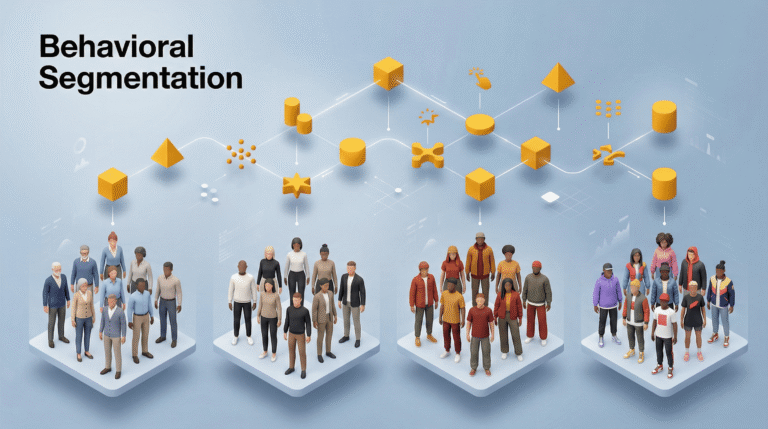
Behavioral segmentation
Behavioral segmentation groups people by observed actions such as purchase history, usage frequency, channel engagement, brand loyalty, and response to promotions.
Common variables and subtypes include:
- Purchase frequency (first-time vs repeat)
- Recency (active vs lapsed users)
- Engagement depth (browsing, time on site, interaction)
- Channel behavior (email engagement, app usage, paid vs organic entry)
- Price sensitivity (full-price vs discount-driven)
- Product usage patterns
As a market segmentation example, consider Amazon. It segments users based on browsing and purchase behavior, surfacing recommendations, promotions, and bundles tailored to observed intent.
Behavioral segmentation is the most operationally powerful subtype. Increasingly, it’s supported by a robust data infrastructure, like
- CRM systems
- Web analytics
- App tracking
- Transaction logs.
More importantly, behavioral data connects directly to economics. It enables market segmentation analysis by:
- High vs low lifetime value (LTV)
- Frequent vs infrequent buyers
- Retained vs churn-risk customers
- Full-margin vs discount-driven cohorts
This is where segmentation shifts from marketing to finance, letting teams:
- Allocate budget toward high-LTV cohorts
- Design retention strategies based on actual usage
- Optimize acquisition toward profitable behaviors
It’s also the ground truth for customer profitability analysis and creating a customer lifetime value formula.
Benefit segmentation
Benefit segmentation groups people by the specific outcome or value they seek from a product or category, regardless of who they are or where they live.
It shifts the focus from identity to intent and desired outcome.
Take toothpaste, for example. Within the same category, customers are segmented by:
- Whitening
- Sensitivity protection
- Cavity prevention
- Natural or chemical-free ingredients
- Kids-focused formulations
These segments cut across demographics vs psychographics, as well as geography. A high-income urban professional and a rural parent may both prioritize sensitivity relief. This is why benefit segmentation is often the most aligned with product strategy.
It also aligns closely with jobs-to-be-done thinking: the idea that customers “hire” products to solve specific problems.
However, it still needs:
- Validation, since stated preferences do not always match actual behavior
- Integration, because benefits must be tied back to measurable outcomes
For example, a skincare brand may identify a “natural ingredients” segment through customer research. But if that segment doesn’t convert or retain at scale, it remains descriptive rather than strategic.
The strongest implementations connect benefit segmentation to behavioral data, linking what customers say they want with what they actually buy.
B2B segmentation approaches: Firmographic, technographic, and intent
B2B customer segmentation analysis groups organizations using firmographic attributes (industry, revenue, employee size), technographic attributes (technology stack and vendor relationships), and intent signals (research behavior and buying-stage indicators).
Here, the unit of decision-making changes. In B2C, you’re influencing an individual or household. In B2B, you’re influencing a buying group, which includes multiple stakeholders with different incentives, operating over longer cycles, often with budget and procurement layers in between.
There are three core lenses to consider this.
Firmographic segmentation answers: What kind of company is this?
- Factors like industry, revenue band, employee count, and geographic footprint are considered.
- This is useful for defining addressable markets and prioritizing accounts. For example, targeting mid-market SaaS companies (200 to 1,000 employees) in fintech or healthcare
Technographic segmentation answers: What tools do they use?
- You may look at CRM systems, cloud providers, marketing stacks, or legacy vs modern infrastructure.
- This is critical for compatibility, switching likelihood, and integration positioning. Consider: Companies using Salesforce vs. those on open-source stacks signal very different migration friction.
Intent-based segmentation answers: Are they actively in-market?
- For this, utilize content consumption, keyword research, product comparisons, and third-party intent data.
- This indicates the buying stage rather than a static profile. For example, you may try acquiring data on accounts researching “data clean rooms” or “marketing mix modeling vendors” within the last 30 days.
Combined, these lenses create an operational perspective.
B2C and DTC segmentation approaches: Behavioral, transactional, and lifecycle
B2C and DTC segmentation groups consumers by their relationship to the brand, combining behavioral signals (what they do), transactional attributes (what they buy), and lifecycle stage (where they are in the customer journey).
Here, the three core lenses are slightly different.
Behavioral segmentation captures interaction patterns:
- Browsing depth, product views, and channel engagement (email, app, paid media)
- Frequency and recency of visits
- Indicates interest and intent signals
Transactional segmentation captures economic behavior:
- Basket size, product mix, and average order value
- Full-price vs discount-driven purchasing
- Purchase cadence and category affinity
- Indicates value contribution
Lifecycle segmentation captures the relationship stage:
- New, active, repeat, high-value, lapsed, or at-risk
- Indicates timing and intervention opportunity
Combining these, a high-value retention segment might look like:
- Customers who purchased more than twice in the last 90 days (behavioral and lifecycle)
- Consistently buy at full price (transactional)
- Engage with email or app notifications (behavioral)
This is where B2C and DTC segmentation diverge from generic frameworks. The unit of analysis is the individual or household. More importantly, brands often own the full journey (from the site to app and emails), creating a first-party data advantage.
What makes a good segment? The five-test quality framework
A good segment passes five tests: measurable, substantial, accessible, differentiable, and actionable. This is the difference between segmentation that describes a market and segmentation that changes decisions.
- Measurable (Can you identify and size it?): You should be able to quantify how many customers fall into the segment and track their behavior over time. For example, “value-conscious shoppers” defined without any observable proxy cannot be identified or tracked in practice.
- Substantial (Is it large or valuable enough to matter?): A segment can be small and still be substantial if it drives disproportionate revenue or margin. Economic weight, instead of size, should be the criterion.
- Accessible (Can you actually reach it?): A segment must be targetable through available channels, like paid media, CRM, or sales. If it can’t be activated, it can’t be acted on.
- Differentiable (Does it respond differently?): Segments should behave differently when exposed to different strategies, like creative, pricing, and channels. If two segments respond the same way, they’re not distinct.
- Actionable (Can you build a distinct strategy around it?): A segment should lead to different decisions: messaging, offers, budget allocation, product positioning.
Together, these five tests form a filter. Segments that pass all five become operational units.
Connecting segmentation to measurement and economics
The bridge between segmentation and decisions is measurement.
First, segmentation defines the populations being measured. Incrementality tests, geo experiments, and marketing mix models evaluate performance across defined groups. If segments are poorly constructed, measurement inherits that flaw.
Second, segmentation becomes meaningful when tied to economics. Behavioral and transactional segmentation enables:
- Customer lifetime value (CLV) by segment
- Contribution margin by segment
- Retention and payback curves by cohort
This reframes segments from descriptive clusters into economic units. For example, a segment with high conversion but low lifetime value may look efficient in-platform but erode margin. Without this layer, segmentation optimizes for mere activity.
Third, segmentation informs capital allocation. Budget decisions, including how much to spend, where to spend it, and on whom, become defensible when tied to segment-level outcomes:
- Which segments generate incremental revenue
- Which segments sustain margin
- Which segments compound over time
This is where segmentation integrates with marketing mix modeling and incrementality testing. Segments that aren’t validated against incremental contribution and economic outcome drift into vanity.
From static segments to a fusepoint-backed system that directs growth
Segmentation only becomes valuable when it changes decisions. The type you choose should follow the business question, and your segments should hold up to the most rigorous quality tests. Anything less is mere categorization.
This is where most approaches find a gap. Segments are defined once, based on surveys or platform audiences, and then treated as a static truth.
- They rarely get tested.
- They rarely get tied back to revenue or margin.
- Over time, they drift away from behavior, performance, and reality.
fusepoint approaches segmentation as a measurement-validated operating layer. Having been pressure-tested against incrementality, these segments help your team decide where growth comes from.
If your current segments aren’t changing how you invest, it may be time to rebuild them on firmer ground with a strategic marketing consultancy like fusepoint.
FAQs
Q: What are the four main types of market segmentation?
A: The four main types of market segmentation are:
- Demographic (who customers are by age, income, education, and similar attributes)
- Geographic (where customers are located)
- Psychographic (their values, attitudes, and lifestyle)
- Behavioral (what they actually do, such as purchase frequency, channel engagement, and brand loyalty)
Most real-world segmentations combine two or more of these types because each one answers a different question about the customer.
Q: What is the difference between market segmentation and customer segmentation?
A: Market segmentation divides the entire addressable market, including people who are not yet customers, into subgroups based on shared characteristics. Customer segmentation focuses specifically on existing customers and groups them by attributes such as purchase behavior, value, or lifecycle stage. Market segmentation informs go-to-market and acquisition strategy, while customer segmentation informs retention, personalization, and lifetime value strategy.
Q: How do you choose the right type of market segmentation?
A: The right type follows the business question. Use demographic and geographic segmentation for media planning and broad reach decisions, behavioral segmentation for targeting and personalization, psychographic and benefit segmentation for messaging and creative decisions, and firmographic, technographic, and intent segmentation for B2B account selection. Most strategic segmentations combine two or three types because no single dimension fully describes how customers actually buy.
Q: What is benefit segmentation?
A: Benefit segmentation groups people by the specific outcome or value they seek from a product or category, regardless of who they are demographically. For example, in toothpaste, the same demographic profile can be segmented into people seeking whitening, sensitivity relief, natural ingredients, or kids’ use. Benefit segmentation is especially powerful for product positioning, messaging, and portfolio decisions because it maps directly to what customers want.
Q: What makes a market segment effective?
A: An effective segment passes five tests:
- Measurable (you can size and identify it)
- Substantial (large enough to matter)
- Accessible (reachable through available media or channels)
- Differentiable (it responds differently than other segments)
- Actionable (you can build distinct strategy or messaging for it)
Segments that fail any of these tests are analytically interesting but operationally weak, which is the most common reason segmentation projects fail to drive real decisions.
Q: How does market segmentation connect to marketing measurement?
A: Segmentation defines the populations that measurement systems analyze. Marketing mix modeling, incrementality testing, and customer lifetime value analysis all depend on well-defined segments to produce decision-grade insights. Without rigorous segmentation, measurement results blur across audiences that respond differently, which weakens the value of the entire measurement program. The reverse is also true: Segments that aren’t validated against incremental contribution or economic outcome eventually drift into vanity.
Q: What are the most common mistakes in market segmentation?
A: The most common mistakes in market segmentation are over-segmenting until segments are too small or too granular to act on, segmenting on demographic data that’s easy to collect but weakly predictive of behavior, building segments that can’t be activated through available channels, treating segmentation as a one-time research deliverable, and failing to validate segments against incremental contribution or economic outcome.
Q: How often should market segmentation be updated?
A: Segmentations should be reviewed at least annually and refreshed whenever there’s a significant shift in customer behavior, market conditions, product portfolio, or measurement infrastructure. Static segmentations built on data that’s two or three years old typically misrepresent the current customer base. This leads to messaging, channel, and budget decisions based on a market that no longer exists.
Sources:
JSTOR. Market Segmentation, Product Differentiation, and Marketing Strategy. https://www.jstor.org/stable/1251125
ScienceDirect. Safety evaluation for ingredients used in baby care products: Consideration of diaper rash. https://www.sciencedirect.com/science/article/pii/S0273230017302830
The University of North Carolina at Chapel Hill. An Analysis of Patagonia’s Green Marketing Appeals on Instagram and Facebook Posts and People’s Comments on Worn Wear. https://cdr.lib.unc.edu/downloads/fx719w85d?locale=en
ScienceDirect. NLP-driven customer segmentation: A comprehensive review of methods and applications in personalized marketing. https://www.sciencedirect.com/science/article/pii/S2666764925000463
ResearchGate. Unveiling Customer Needs: A Comprehensive Exploration of Jobs to be Done Interviews. https://www.researchgate.net/publication/379988396_Unveiling_Customer_Needs_A_Comprehensive_Exploration_of_Jobs_to_be_Done_Interviews
ResearchGate. Bricks or clicks? Consumer channel choice and its transport and environmental implications for the grocery market in Norway. https://www.researchgate.net/publication/347843443_Bricks_or_clicks_Consumer_channel_choice_and_its_transport_and_environmental_implications_for_the_grocery_market_in_Norway
Our Editorial Standards
Reviewed for Accuracy
Every piece is fact-checked for precision.
Up-to-Date Research
We reflect the latest trends and insights.
Credible References
Backed by trusted industry sources.
Actionable & Insight-Driven
Strategic takeaways for real results.
Emily Sullivan is an experienced marketing professional with over a decade of expertise in content creation, communications, and digital strategy. She thrives on translating complex, technical subject matter into content that is approachable, insightful, and genuinely useful to marketing professionals navigating a fast-evolving landscape.